
Master psychological thriller craft by writing from inside the character. Let us learn how internal wounds drive tension, perception, and story power.
Psychological Thriller Craft begins with breaking of something inside the character, not the crime committed in the plot.
Contrary to what many believe, this genre is not powered by events, but by internal instability. Writers who misunderstand this build mysteries. Writers who understand this build psychological descent.
There is a distinction.
And this distinction determines whether a script becomes a disposable thriller, or an enduring psychological property. My aim with Yohana’s world is the latter.
At its highest level, psychological thriller craft is about psychological truth. And that truth must exist before the plot does.
Psychological Thriller craft begins with a psychological Truth
At its core, psychological thriller craft is built on one non-negotiable principle:
“An unresolved wound must drive the narrative”
A Mystery story asks:
What happened?
A Psychological thriller story asks:
What is happening inside this person that makes his or her reality unstable?
That internal instability is the engine.
The wound may take many forms. Like:
- Abandonment
- Guilt
- Identity collapse
- Control disorder
- Trauma repression
- Moral dissociation
But without that wound, tension becomes external.
And in my opinion, external tension belongs to crime drama, not psychological thriller.
In true psychological thriller craft, plot is just a catalyst. The wound is the real engine.
If the protagonist were psychologically stable, the story would collapse.

In my screenplay Yohana’s World, the core wound is abandonment.
Not metaphorical abandonment. Childhood abandonment.
The National Library of Medicine has an article linking Childhood abandonment with Maladaptive Daydreaming, something which Yohana is undergoing throughout her life. Do read this short article to learn more.
Now, Yohana believes she was left behind. Emotionally, psychologically and existentially. In response, she constructed an internal family to survive. What began as coping evolved into a well-designed system.
From the opening image, a wounded hand reaches toward a ringing phone. “Son Calling.” “Daughter Calling.” The connection exists, but cannot be reached.
That is abandonment staged as visual language.
The audience must receive psychological truth. Otherwise things are likely to tumble down.
Remember this as the foundation of a psychological thriller craft: the wound is introduced before the plot context. The viewer subconsciously must become aware that the instability precedes the crime.
And when instability precedes the crime, perception becomes suspect from frame one.
Psychological Thriller vs. Mystery
One of the most common craft errors in the genre is confusing mystery with psychological thriller.
Mystery builds tension through withheld information.
Psychological thriller builds tension through destabilized perception.
Mystery operates on:
- Question
- A clue
- Revelation
Psychological thriller operates on:
- Stability
- Distortion
- Deterioration
Mystery protects objective reality. Psychological thriller interrogates it.
Mystery makes the audience curious. Psychological thrillers make the audience uncertain.
Uncertainty, when controlled is far more powerful than curiosity.
Advanced psychological thriller craft does not aim to confuse. It aims to destabilize.
If the audience feels lost, the writer has failed.
If the audience feels uneasy but remains oriented, the writer has succeeded.
In case of Yohana, she is competent. She pursues criminals. She analyzes. She inspects crime scenes. She confronts suspects.
Objectively speaking, she functions.
But her perception layers over reality.
- A puppy speaks to her in a human voice.
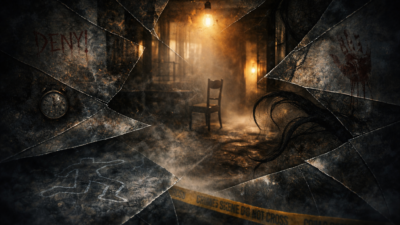
- Words appear on walls instructing her to “SAY NO!” and “DENY!”
- Auras form during emotional conflict.
These distortions are not random hallucinations. They are translations of her emotional state.
The audience will get to see two simultaneous realities:
- The observable world.
- Yohana’s internal rendering of it.
This dual-layer design is disciplined psychological thriller craft. The tension now does not come from “Who is the Killer?”
It comes from:
Can we trust Yohana what she is showing us?
That shift elevates the material from procedural to psychological.
Reality vs. Perception: The core engine of Psychological Thriller Craft
Every serious psychological thriller must operate with two realities:
- The shared, objective environment.
- The protagonist’s internalized perception of that environment.
The craft challenge is maintaining misalignment without losing coherence.
If the subjective world dominates completely, the narrative drifts into surrealism.
If the objective world dominates completely, the narrative becomes procedural.
Psychological thriller craft lives in controlled misalignment.
The protagonist believes their interpretation.
The audience suspects something is wrong.
That gap is the real tension.
As the story progresses, the gap widens and it should widen.
That widening is called deterioration in context of a psychological thriller.
And this deterioration is more powerful than revelation.
Because remember, revelation shocks and deterioration unsettles.
Shock however fades, perhaps seeing a new flavour of popcorn at the cinema house.
Unsettling lingers. It will keep you guessing, which popcorn flavour you had during the entire film time.
Now, Yohana’s inner circle. That is Zuri, Ayden, Frank and Alice, all appear to function as independent individuals. They argue. They advise. They challenge her decisions.
Yet structurally, they operate as psychological partitions.
- Zuri regulates with logic.
- Ayden deflects with emotion.
- Frank preserves innocence.
- Alice provokes creativity.
In the car scene on Page 6 of the screenplay, when Yohana slaps herself and the world momentarily destabilizes, reality in itself does not break.
Her perception does.
This is identity collapse in controlled motion.
In my previous Post, I have explored how a screenwriter must learn to think like a filmmaker while writing a psychological thriller story. You never know, when character perception dwindles and what changes are likely to happen during the shoot of the film script.
Now, psychological thriller craft is more about showing the mechanics of internal fragmentation with discipline rather than portraying madness.
Yohana is not erratic. She is designed. Or I can say, she has designed herself.
That construction is what makes her collapse compelling.
Deterioration before Revelation
I genuinely believe, weak thrillers chase twists.
Strong psychological thrillers design deterioration.
The audience must watch the protagonist deteriorate before they are ready to confront truth.
If the reveal arrives before emotional erosion, it will feel mechanical.
Here, deterioration accomplishes three things:
- It escalates stakes organically.
- It deepens audience empathy.
- It prepares the narrative for inevitable confrontation.
Psychological thriller craft prioritizes inevitability over surprise.
When the reveal finally arrives, it should feel earned, not engineered.
In the screenplay on Page 17, when Michelle pleads for help, Yohana does not respond as a detective.
She responds as a wounded child.
A flash of teenage Yohana being thrown out of a villa interrupts the present.
The case she is pleaded to take, is not external anymore. It reactivates that childhood abandonment.
The diary she clutches in her hand is her control mechanism. A self-authored world constructed to prevent her collapse.
When walls form the word “DENY!”, the audiences at first may feel it like a supernatural spectacle, but in fact it is Yohana’s psychological resistance.
The crime forces confrontation. Her psyche forces preservation.
How Psychological Thriller Craft shapes every creative decision
A genuine psychological thriller mindset affects everything:
- Opening image.
- Character design.
- Dialogue rhythm.
- Visual language.
- Pacing.
- Even the moment of complete silence.
When writing from deterioration, you must not ask: what would make this scene exciting?
You should ask: what would destabilize this character?
In Yohana’s World, recurring motifs are not decorative in nature.
- The jasmine bud slowly opening mirrors suppressed truth surfacing.
- The shadow tendril in the opening image establishes internal engulfment Yohana is about to feel.
- Flickering lights, fractured surfaces, reflective imagery, all of these are psychological continuity markers.

This is advanced psychological thriller craft: designing coherence across narrative and visual layers.
For investors and producers, this distinction matters.
Twist-or-shock dependent thrillers are trend-driven. Character-driven thrillers are evergreen.
They age through theme, not gimmick.
Why Psychological Thriller Craft matters
The current market is saturated with high-concept twists and short-term shock value.
What sustains value is psychological system.
A thriller rooted in character:
- Attracts performance-driven actors.
- Encourages repeat viewing.
- Supports layered marketing.
- Enables symbolic branding.
- Sustains franchise expansion through psychological depth.
Yohana’s World is such a thriller rooted story.
Its core wound, abandonment is universal.
Its execution, controlled perception distortion is scalable.
That makes it not just a script. But a structured psychological IP.
Now available for direct acquisition at $555,000
The entire package includes:
- A complete 118 page screenplay.
- Scene-by-scene structural breakdown.
- Detailed character psychology profiles.
- Visual language architecture.
- Thematic and symbolic design framework.
- Long-term scalability analysis.
I present to you a fully engineered psychological property built on abandonment, identity collapse and controlled perception distortion.
Serious story collectors, investors, producers and acquisition executives may inquire directly and register their interest on Yohana’s World website.