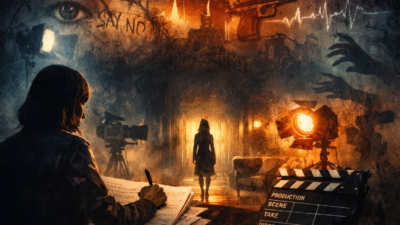

Cinematic screenwriting is the art of making a script feel like a film before a single frame is shot.
When done well, the reader does not feel like they are reading instructions. They feel like they are watching a movie unfold.
This is one of the most misunderstood aspects of modern screenwriting.
Many writers assume that to make a script cinematic they must include camera directions:
CLOSE ON.
TRACKING SHOT.
CAMERA PUSHES IN.
But in professional spec scripts, camera instructions are rarely necessary. In fact, they often weaken the reading experience.
The director determines the camera.
The writer determines the image.
And that distinction is where cinematic screenwriting truly lives.
A powerful screenplay creates images so clear that the camera naturally suggests itself.
In psychological thrillers especially, the ability to write visually without technical instructions becomes a critical skill. Atmosphere, tension, internal conflict and psychological pressure all rely on imagery rather than explanation.
In my psychological thriller screenplay Yohana’s World, this principle guided nearly every scene. The goal was never to tell the camera what to do, it was to create images that could not help but become cinematic.
My article today explores the craft of cinematic screenwriting: how to create visual storytelling on the page without breaking screenwriting rules.
Visual screenwriting begins with implication
One of the core principles of cinematic screenwriting is implication.
A screenplay is still a visual document.
The trick is in understanding how to guide the reader’s attention without instructing the camera.
Instead of writing:
CLOSE-UP ON THE KNIFE.
You simply write the image:
A knife glints under the kitchen light.
The reader’s mind will immediately move closer to the object. The image itself implies the framing.
This is the secret behind cinematic screenwriting: clarity of imagery replaces technical direction.
When the description is precise enough, the reader naturally imagines the shot.
Professional screenplays rely on this principle constantly.
Objects enter focus. Movement pulls attention. Details emerge through context.
The camera remains invisible, but the images remain vivid.
This allows the script to remain readable while still feeling cinematic.
In the opening scene of Yohana’s World, the screenplay never instructs a camera movement.
Instead, it describes a wounded hand struggling to reach a ringing phone on a deserted road.
The image alone implies proximity.
A reader instinctively imagines the moment visually.
No “close-up” instruction is required.
Later in the same sequence, a shadow crosses the frame before violence erupts.
Again, no camera language appears on the page.
The shadow itself is the focus.
This is cinematic screenwriting functioning as intended:
“Images guiding perception instead of technical instructions guiding the camera.”
Writing psychological states visually
Film cannot photograph thoughts.
But it can photograph the consequences of thoughts.
This is one of the most powerful tools in cinematic screenwriting.
Many scripts attempt to describe internal emotion directly:
“She feels anxious.”
“He is overwhelmed.”
“She struggles internally.”
But these are literary descriptions.
Cinema requires physical manifestations of psychology.
Instead of describing emotion, a cinematic screenplay describes what emotion does to the environment.
Hands tremble.
Objects shift.
Breathing changes.
Focus collapses.
The audience reads psychological tension through visual cues.
Psychological thrillers rely heavily on this technique because internal conflict is the engine of suspense.
If the character’s mental state cannot be seen, the tension remains abstract.
Cinematic screenwriting transforms internal emotion into visual behavior.

In Yohana’s World, internal psychological states frequently distort the environment.
When Yohana slaps herself while driving, the buildings around her appear to wobble slightly, reflecting her unstable mental state.
The script never explains her thoughts.
Instead, the environment reflects them.
Later, words like “SAY NO” and “DENY” appear carved into walls as her internal conflict intensifies.
These visual disturbances externalize psychological pressure.
The audience witnesses her mental state rather than being told about it.
This is one of the defining strengths of cinematic screenwriting:
“Emotion becomes image.”
When to show and when to withhold
Another crucial element of cinematic screenwriting is restraint.
Not everything should be shown clearly.
Not everything should be explained.
Cinema thrives on selective revelation.
The screenwriter’s task is to decide when an image should be fully visible and when it should remain partially hidden.
This balance creates suspense.
If every action is described completely, tension disappears.
If nothing is revealed, confusion replaces intrigue.
The most effective visual storytelling lies between those extremes.
Fragments appear. Sounds echo. Shadows move before objects are seen.
The audience assembles the meaning piece by piece.
This technique is particularly powerful in psychological thrillers because uncertainty amplifies tension.
Cinematic screenwriting uses absence just as carefully as presence.
In the morgue sequence of Yohana’s World, the environment gradually collapses into darkness.
Lights flicker.
Metal scrapes echo across the room.
The audience senses movement before any threat becomes visible.
The script deliberately withholds clarity.
The reader experiences the same uncertainty as the character.
The moment works precisely because the full picture is not revealed immediately.
This is a core technique in cinematic screenwriting:
What you hide often matters more than what you show.
Visual metaphors that carry Theme
Great screenplays rarely rely on dialogue to express theme.
Instead, they embed meaning into recurring images.
These are visual metaphors.
A cracked mirror might symbolize broken identity.
A dying flower might represent fading hope.
A flickering light might suggest unstable truth.
Visual metaphors allow the film’s themes to exist without speeches.
They become silent reminders of the protagonist’s internal journey.
In psychological thrillers, these metaphors often appear repeatedly, evolving alongside the character’s emotional state.
Because cinema is visual by nature, metaphor expressed through imagery often resonates more strongly than verbal explanation.
Cinematic screenwriting therefore relies on symbolic objects and recurring visual motifs.

Several visual motifs recur throughout Yohana’s World.
The purple diary appears repeatedly as a psychological anchor for Yohana’s past.
Shadows behave unnaturally during moments of emotional strain.
Jasmine buds slowly open across the narrative, reflecting buried memories resurfacing.
These images reinforce theme without dialogue.
The audience absorbs emotional meaning through repetition and transformation.
That is the essence of cinematic screenwriting:
“Theme expressed visually rather than explained verbally.”
The Art of minimalism
One of the most counterintuitive lessons in cinematic screenwriting is that fewer words often create stronger images.
Many writers attempt to make their scripts cinematic by adding more description.
But the opposite is usually true.
Overwritten description slows the reading experience and dilutes imagery.
Strong screenplays use minimal language with maximum clarity.
Consider the difference:
An abandoned, dusty hallway filled with broken furniture and flickering lights.
Versus:
A narrow hallway. One flickering light. A door at the end.
The second version produces a clearer mental image.
Minimalism focuses attention.
Attention produces visual impact.
The most effective cinematic screenwriting uses concise description that allows the reader’s imagination to complete the frame.
Several scenes in my screenplay Yohana’s World rely on minimalist visual description.
A chalk outline on asphalt.
A shadow stretching toward a clenched fist.
A diary gripped too tightly.
These brief descriptions generate strong images without elaborate language.
The script trusts the reader’s imagination.
And when a screenplay trusts its reader, the reading experience becomes more cinematic.
The invisible camera
The highest level of cinematic screenwriting occurs when the camera disappears entirely.
Not because the film lacks visual direction.
Because the visual flow becomes so natural that technical language is unnecessary.
The reader experiences the screenplay as a sequence of images rather than a series of written instructions.
Movement emerges organically. Attention shifts naturally. Shots appear implicitly.
This is the invisible camera.
When a screenplay reaches this level, the page stops feeling like text.
It begins to feel like cinema.
Directors appreciate scripts written this way because they leave room for interpretation while still providing clear visual storytelling.
The writer guides perception without dictating execution.
That balance is the hallmark of professional cinematic screenwriting.

When readers move through Yohana’s World, scenes unfold visually through environment, object interaction and spatial tension rather than technical instruction.
The camera never needs to be mentioned.
The images already exist.
This is the goal of cinematic screenwriting:
“To make the screenplay feel like a film long before production begins.”
Cinematic screenwriting turns words into images
Cinematic screenwriting is all about controlling the image.
When we writers master visual implication, psychological imagery, selective revelation, metaphor and minimalism, their script stop reading like a document.
It begins to read like a film.
Objects become emotional carriers. Silence becomes tension. Space becomes narrative.
The camera never needs to appear on the page because the story already exists visually.
And when a screenplay reaches that point, it becomes far more powerful than a technical blueprint.
It becomes an experience.
And so, this is my confident invitation to you.
If you are serious about mastering cinematic screenwriting at a professional level, Yohana’s World offers a fully designed visual storytelling blueprint.
The screenplay package includes:
• Full 118 page screenplay
• Scene-by-scene breakdown
• Psychological character architecture
• Visual language framework
• Structural beat map
I present to you, a complete cinematic design system built for psychological storytelling.
The entire package is available for direct acquisition at $555,000.
Register your interest on Yohana’s World official website.
Because when cinematic screenwriting is engineered correctly, the screenplay does not simply describe a film.
It already is one.