
Adapting cinematic atmosphere is one of the most powerful storytelling decisions taken by screenwriters and filmmakers in psychological thrillers.
Long before dialogue reveals meaning or plot twists reshape the narrative, atmosphere determines how the audience feels within a scene. Lighting, space, colour and environmental texture begin shaping emotional tension even when nothing dramatic appears to be happening.
This is what separates psychological thrillers from many other genres.
Traditional thrillers rely heavily on events. Action, danger and external conflict drive the narrative forward.
Psychological thrillers operate differently.
They create tension through experience.
Instead of asking only “What happens next?”, the filmmaker asks something more fundamental:
“What should the audience feel right now?”
The answer to that question often lies not in dialogue or plot mechanics but in cinematic atmosphere.
Atmosphere transforms the environment into an emotional amplifier. The world surrounding the protagonist begins to mirror their internal state. Light becomes oppressive. Empty space begins to feel like isolation.
When executed properly, atmosphere can sustain tension even in moments of stillness.
A character walking through an empty hallway can feel more unsettling than a violent confrontation if the cinematic atmosphere is carefully constructed.
Psychological thrillers therefore treat the environment as a narrative instrument. The space itself participates in storytelling.
My article explores how cinematic atmosphere functions as a narrative weapon in psychological thrillers. We will examine how space, colour, texture and visual rhythm shape emotional tension and how filmmakers use environmental design to reflect the protagonist’s psychological condition.
When cinematic atmosphere aligns with character psychology, tension becomes unavoidable, even when there is nothing happening.
The Psychology of atmosphere in Psychological Thrillers
Atmosphere is often misunderstood as visual decoration.
Many people assume it simply refers to stylistic choices such as lighting, colour palettes or production design.
In psychological thrillers, however, atmosphere functions as an emotional framework.
The environment surrounding the character becomes an extension of the protagonist’s psychological state.
This is where cinematic atmosphere begins to operate as a narrative tool.
Rather than simply providing a setting, the environment begins reflecting emotional tension.
- Space becomes isolation.
- Light becomes interrogation.
- Texture becomes discomfort.
These sensory cues shape how the audience experiences the scene long before any explicit narrative meaning emerges.
Psychological thrillers frequently use this technique to sustain tension during moments when nothing significant appears to happen on the surface.
A character may simply stand in a room.
But if the lighting is harsh, the space feels empty and the soundscape is unnaturally quiet, the viewer senses unease.
The atmosphere begins communicating something that the plot has not yet revealed.
This is why many of the most unsettling moments in psychological cinema involve stillness rather than action.
The environment itself becomes the source of tension.
When cinematic atmosphere is designed carefully, the audience experiences the protagonist’s psychological instability through sensory immersion rather than exposition.
In Yohana’s World, environments often mirror Yohana’s emotional condition.
Spaces rarely feel neutral.
Instead, they carry subtle psychological weight.
Certain locations appear dimly lit, with shadows stretching unnaturally across surfaces. Reflective textures distort perception, creating the impression that the environment itself is watching.
Flickering lights occasionally interrupt visual stability.
These details form part of the film’s cinematic atmosphere, reinforcing the idea that Yohana’s perception of the world is not entirely stable.
The viewer does not simply observe Yohana’s psychological tension.They experience it through the physical space surrounding her.
The atmosphere becomes a visual representation of the internal conflict driving the narrative.
Space and isolation
One of the most powerful elements of cinematic atmosphere is spatial design.
The way characters occupy space dramatically influences the emotional tone of a scene.
Psychological thrillers frequently manipulate spatial balance to create tension.
Large empty environments can evoke vulnerability.
A character standing alone in an oversized room may appear exposed and fragile. The surrounding emptiness emphasizes their isolation.
Conversely, confined spaces can evoke suffocation.
Tight corridors, low ceilings and narrow rooms create a sense of psychological pressure.
In both cases, the spatial environment influences how the audience emotionally interprets the character’s situation.
These spatial manipulations are rarely accidental.
Filmmakers often position characters within environments that subtly mirror their emotional state.
Distance between objects, empty space behind the character and unusual framing can all contribute to cinematic atmosphere.
The viewer may not consciously analyze these spatial choices, but their emotional impact is immediate.
The environment begins to feel slightly unnatural.
And that subtle imbalance generates tension.
In Yohana’s World, spatial design frequently reflects Yohana’s psychological disorientation.
Certain environments appear unusually empty.
Crime scenes feel frozen in time as though the world has paused to observe the aftermath of violence.
Other locations feel slightly too enclosed, creating the impression that Yohana’s thoughts are closing in around her.
The environment subtly communicates emotional instability.
- Rooms feel larger than they should.
- Hallways seem longer.
- Shadows stretch beyond natural proportions.
These spatial distortions reinforce the film’s cinematic atmosphere, suggesting that the world Yohana inhabits may not entirely align with objective reality.
The audience senses that something within the environment is emotionally charged.
And that sensation deepens the psychological tension.
Sonic absence
Sound design too plays a critical role in psychological thrillers.
However, one of the most powerful tools in cinematic atmosphere is not sound itself—but silence. Quietude.
Quietude narrows the viewer’s sensory focus.
When the surrounding soundscape disappears, small details become amplified.
- Footsteps echo louder.
- Breathing becomes noticeable.
- Distant environmental noises suddenly feel threatening.
This sensory narrowing increases the audience’s psychological engagement.
The viewer begins listening more carefully.
Every small sound carries potential meaning.
In many psychological thrillers, quietude creates tension precisely because it leaves space for anticipation.
The audience expects something to interrupt the stillness.
This expectation produces emotional pressure.
The absence of sound becomes as expressive as music or dialogue.
When used effectively, quietude transforms the environment into a psychological chamber where the viewer’s attention is completely focused on the character’s experience.
This is why cinematic atmosphere often relies heavily on sonic restraint.
Sound design becomes less about adding noise and more about shaping absence.
In Yohana’s World, moments of emotional intensity are frequently accompanied by quietude.
As Yohana confronts situations that trigger memories or psychological discomfort, the surrounding soundscape begins to fade.
- The environment becomes unnaturally quiet.
- Street noise disappears.
- Ambient sounds vanish.
- The world seems to hold its breath.
This sonic absence forces the audience to focus entirely on Yohana’s internal state.
Her breathing, footsteps and subtle movements become amplified within the quietude.
The absence of sound reinforces the film’s cinematic atmosphere, heightening tension without relying on dramatic action.
Silence becomes a narrative gesture.
Something within Yohana’s mind is shifting.
Colour and emotional coding
Colour functions as a powerful emotional language too in cinematic storytelling.
Psychological thrillers do rely on carefully controlled colour palettes to shape the viewer’s emotional response.
- Cool tones may evoke detachment or unease.
- Muted colours can create emotional distance.
- Sudden colour contrasts may signal psychological rupture.
The viewer may not consciously register these colour shifts, but their emotional influence is significant.
In psychological thrillers, colour often reflects the protagonist’s psychological state.
Scenes dominated by cold tones may accompany moments of emotional isolation.
Warmer tones may appear when memories or emotional vulnerability surface.
These subtle visual cues strengthen the film’s cinematic atmosphere, allowing emotional meaning to emerge visually rather than verbally.
Colour becomes an invisible storytelling layer.
In Yohana’s World, colour motifs appear throughout the narrative.
One recurring visual anchor is Yohana’s purple diary.
The object carries symbolic weight, representing emotional memory and personal history.
Other scenes rely on warm interior lighting that contrasts with darker surrounding shadows.
These colour choices reinforce the story’s cinematic atmosphere by subtly guiding the audience’s emotional interpretation of each environment.
The world surrounding Yohana reflects her internal condition.
Colour becomes another language through which the narrative communicates psychological tension.
Feelings-first sequences
Traditional storytelling structures often build scenes around events.
Something happens.
Characters react.
The plot moves forward.
Psychological thrillers frequently reverse this approach.
Instead of beginning with action, filmmakers often begin with emotion.
The guiding question becomes:
“What should the audience feel?”
From there, visual rhythm, lighting transitions, sound design and pacing are designed to produce a specific emotional experience.
These moments are known as feelings-first sequences.
In such sequences, the viewer may not immediately understand the narrative significance of what they are seeing.
But they feel the tension.
The emotional experience precedes intellectual interpretation.
This technique allows the decision of cinematic atmosphere to shape the viewer’s psychological engagement before the plot fully explains the moment.
The environment, lighting, sound and pacing combine to create an emotional sensation.
Meaning emerges later.
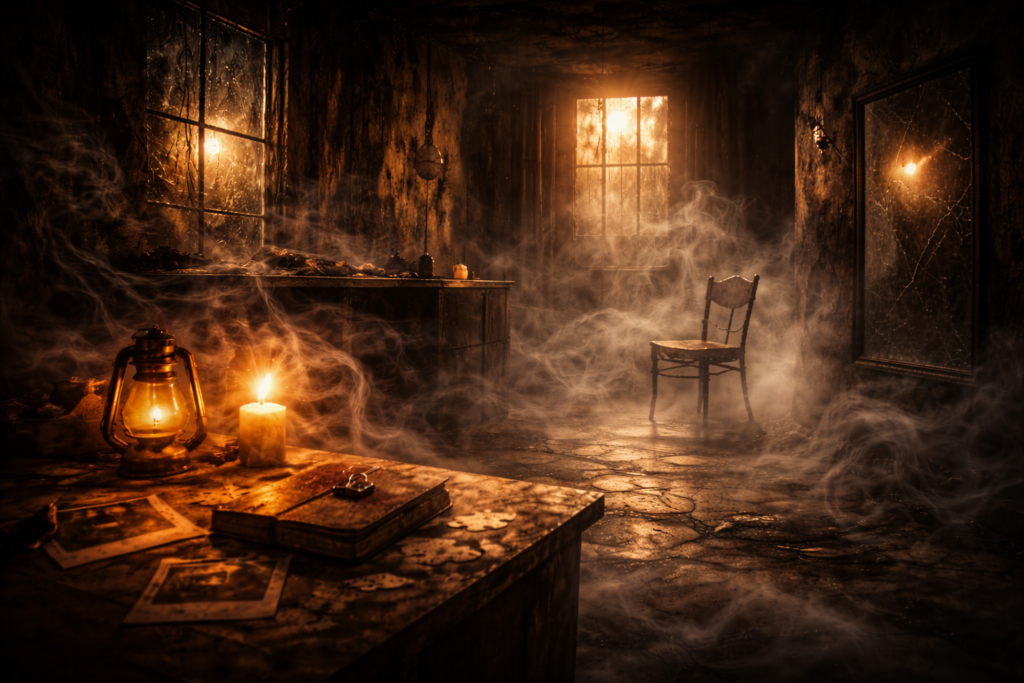
Several sequences in Yohana’s World operate through this feelings-first approach.
The viewer experiences Yohana’s emotional state through atmospheric design before the narrative fully reveals its significance.
- Lighting shifts.
- Environmental textures become more pronounced.
- Quietude deepens.
These sensory cues shape the viewer’s emotional reaction to the moment.
Only later does the narrative clarify what those feelings represent.
This technique allows cinematic atmosphere to function as a narrative tool.
The audience experiences the psychological weight of the story before understanding it intellectually.
When atmosphere becomes story
Psychological thrillers do not rely solely on plot to generate tension.
They rely on experience.
Cinematic atmosphere transforms environments into emotional landscapes. The viewer inhabits the protagonist’s psychological journey. And they must.
Space, quietude, colour and sensory design begin communicating emotional meaning long before dialogue explains the narrative.
When these elements align with character psychology, tension becomes unavoidable.
Even the quietest moment can feel unsettling.
And when the audience begins to experience the world through the protagonist’s emotional lens, the story becomes more than a sequence of events.
It turns into an immersive atmosphere, eagerly waiting to be explored.
Yohana’s World is currently available for direct acquisition at $555,000
Included in the package:
• Complete feature 118 page screenplay
• Scene-by-scene structural architecture
• Character psychology profiles
• Visual language framework
• Symbolic and thematic design system
This is a cinematic narrative built around psychological perception, environmental storytelling and carefully designed cinematic atmosphere on the script stage.
You can register your interest on Yohana’s World official website.
Feel free to read the first 21 pages of the screenplay here.
For producers and investors seeking a psychologically layered thriller with strong visual identity:
Yohana’s World is here for you.