

Worldbuilding in films is often misunderstood as a function of scale.
Ask most people what makes a cinematic world feel immersive and the answers will follow a familiar pattern: sprawling cities, international locations, elaborate set pieces and visually overwhelming production design.
The assumption is simple: bigger equals better.
But psychological thrillers quietly dismantle this belief.
They prove that immersion is created by experience.
For producers, this distinction is strategic. Because if immersion can be achieved without expansion, then worldbuilding in films becomes a financial advantage.
A confined space can feel infinite if it carries enough psychological weight. A single room can hold more tension than an entire city if the audience experiences it through the right lens. And a controlled production can feel expansive without ever stretching its budget.
This is where psychological worldbuilding becomes powerful.
It replaces physical scale with emotional depth. It substitutes logistical complexity with sensory precision.
And most importantly, it allows producers to build worlds that feel vast without spending like they are.
The illusion of scale vs the reality of experience
Traditional approaches to worldbuilding in films often prioritize expansion.
The logic is straightforward: to create a sense of scale, the film must show scale. This leads to decisions such as:
- multiple international locations
- expansive cityscapes
- large-scale production design
- frequent environmental shifts
While these choices can be visually impressive, they also introduce significant production challenges:
- increased logistical coordination
- higher transportation and setup costs
- scheduling inefficiencies
- budget volatility
Yet, despite these investments, scale does not always translate into immersion.
Because audiences do not experience scale purely through geography.
They experience it through perception.
A film can move across five countries and still feel emotionally flat. Conversely, a film set almost entirely in one location can feel expansive if the audience is psychologically engaged.
This is where psychological thrillers redefine worldbuilding in films.
They create scale through:
- emotional depth
- sensory manipulation
- narrative layering
Instead of expanding outward, they deepen inward.
The result is a world that feels larger than it physically is.
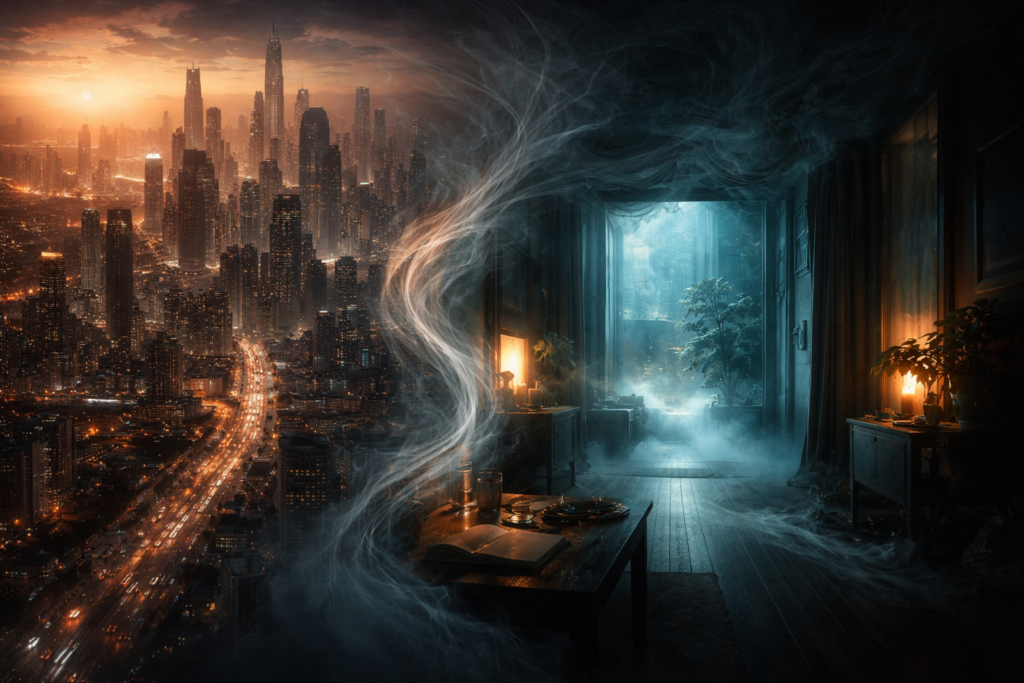
In Yohana’s World, the sense of scale needs to come from instability.
Reality must not be fixed. Perception is to be kept fluid. Emotional states need to reshape environments. A space that feels safe in one moment must feel threatening in another. Familiar surroundings will need to begin shifting to meaning.
What this will do is create a layered experience.
The audience will then experience them through Yohana’s psychological lens.
A single environment can contain multiple emotional realities.
This is how Yohana’s World needs to approach worldbuilding in films.
By expanding perception.
Atmosphere as a core tool
Atmosphere is one of the most efficient tools in worldbuilding in films, yet it is often underestimated.
Unlike large-scale production design, atmosphere simply requires precision.
Atmosphere here, is created through:
- lighting design
- sound design
- color palette
- spatial composition
Each of these elements influences how the audience feels within a space.
A dimly lit room can feel oppressive. A quiet environment can feel threatening. A slight shift in color temperature can alter emotional tone.
These changes are subtle, but their impact is significant.
For producers, atmosphere offers a powerful advantage:
It allows the same physical space to generate different emotional experiences without requiring additional locations or infrastructure.
This makes it one of the most cost-effective strategies in worldbuilding in films.
Now, atmosphere is central to the design of Yohana’s World.
The environments in the story need to be defined by emotional texture.
Lighting must be used to obscure and reveal. Sound must be used in a way to suggest what cannot be seen. Color subtly should shift to reflect psychological states.
The world must feel alive not because it is large, but because it is responsive.
It needs to react to Yohana’s internal condition.
This approach will allow the film to maintain immersive worldbuilding without expanding production scale, demonstrating how atmosphere can become the foundation of worldbuilding in films.
Repetition and variation: making small worlds feel large
One of the most effective techniques in worldbuilding in films is repetition with variation.
Instead of constantly introducing new environments, producers and filmmakers revisit the same locations, but alter them.
This can be achieved through:
- changes in lighting
- shifts in framing
- alterations in sound
- evolving emotional context
The audience begins to recognize the space, but each return feels different.
A hallway that once felt neutral may later feel threatening. A room that once felt safe may become oppressive.
This creates the illusion of expansion.
The world feels dynamic, even though its physical footprint remains unchanged.
For producers, this technique offers a significant advantage:
It maximizes the value of each location while minimizing additional costs.
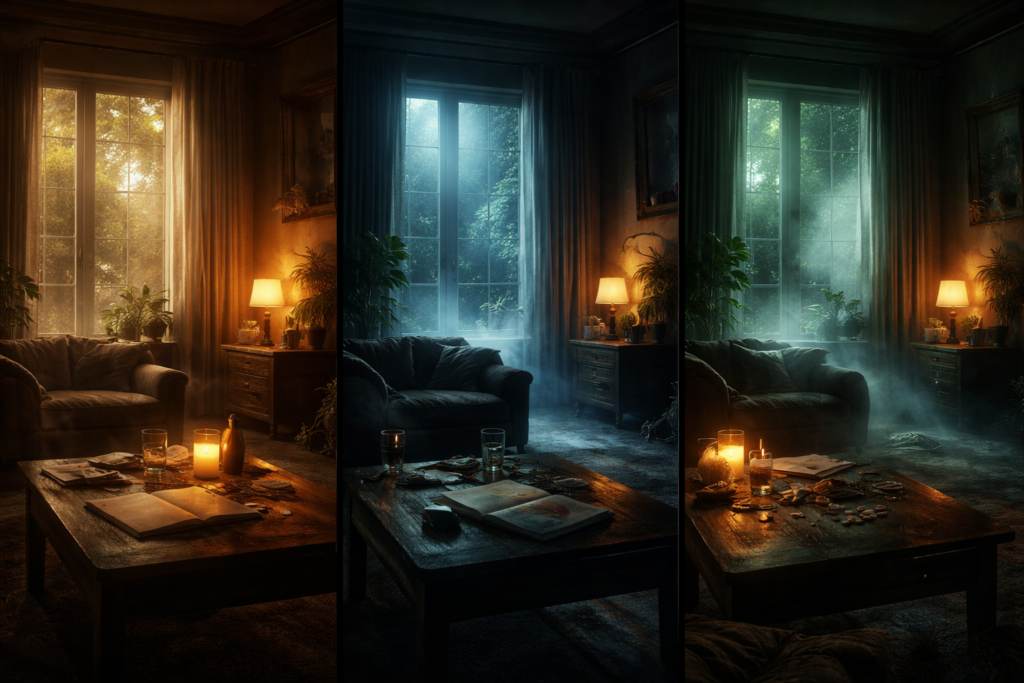
In Yohana’s World, repetition is intended to be used as a storytelling tool.
Spaces must evolve alongside Yohana’s psychological state.
The same environment can appear:
- grounded
- distorted
- surreal
This variation will transform static locations into dynamic narrative elements.
The audience will then experience the world as fluid rather than fixed.
This is a key example of how worldbuilding in films can achieve scale through transformation rather than expansion.
Sound Design in Worldbuilding
Sound is one of the most underutilized tools in worldbuilding in films.
While visuals define what the audience sees, sound defines what they feel beyond the frame.
Sound can:
- suggest unseen spaces
- create tension through absence
- expand perceived environment
- guide emotional response
A distant noise can imply a larger world. Silence can create discomfort. Subtle ambient sounds can make a space feel alive.
Unlike visual expansion, sound design does not require physical construction.
It allows filmmakers to build a world that extends beyond what is visible.
For producers, this makes sound one of the most cost-efficient tools for creating immersion.
Sound in Yohana’s World needs to be narrative rather than just supportive.
It should contribute to:
- psychological unease
- environmental ambiguity
- emotional tension
The audience need to hear more than they see.
This will create a sense of depth that will extend beyond the physical environment.
It will ultimately reinforce the film’s approach to worldbuilding in films.
Expanding perception rather than geography.
Symbolism in Worldbuilding
Symbolism adds depth to worldbuilding in films without increasing physical scale.
Recurring visual elements can:
- connect different scenes
- reinforce thematic ideas
- create continuity across environments
These elements act as anchors within the narrative.
They give the audience a sense of cohesion, even when the story shifts.
Symbolism allows a film to feel layered and interconnected without requiring additional locations or production complexity.

In Yohana’s World, symbolic elements (like the purple diary or the jasmine bud) recur across different moments.
They carry emotional meaning and reflect Yohana’s internal state.
These elements:
- link scenes together
- reinforce psychological themes
- deepen audience interpretation
This creates a world that feels cohesive and layered.
It demonstrates how worldbuilding in films can achieve depth through meaning rather than simply scale.
Controlled environments in Worldbuilding
Reducing location count is one of the most effective ways to control production costs.
However, fewer locations do not mean reduced immersion.
When designed thoughtfully, controlled environments can:
- increase narrative focus
- strengthen emotional continuity
- simplify production logistics
In psychological thrillers, fewer locations often enhance the experience by keeping the audience within a consistent emotional space.
This aligns with efficient worldbuilding in films, where depth replaces expansion.
Yohana’s World too uses a controlled set of environments.
Each location is carefully chosen and designed to support the story’s psychological tone.
I have written them, but for a producer, these spaces will need to be portrayed as an extension of the narrative.
All the locations hold emotional weight.
This approach will allow the film to maintain immersion while remaining production-efficient.
The Producer’s role in Worldbuilding
So, what is your role here. A highly critical one.
Your decisions will influence:
- location selection
- budget allocation
- production design priorities
- sound and lighting investment
As I understand it, worldbuilding is not just a creative decision, it requires strategy too.
Producers determine whether a film builds:
- a physically expansive world
or - a psychologically immersive one
The difference between these approaches has significant financial implications.
A producer who understands psychological worldbuilding can create a film that feels expansive while maintaining budget discipline.

The world of Yohana’s World is designed through a producer-aware lens.
Every decision supports:
- controlled scale
- atmospheric richness
- psychological immersion
This ensures that the world feels immersive without inflating production complexity.
Producer Takeaway and next steps
Worldbuilding in films does not need to be expensive to be effective.
Psychological thrillers demonstrate that:
- atmosphere can replace scale
- sound can expand space
- repetition can create variation
- symbolism can add depth
For producers, this offers a clear strategic advantage.
Worldbuilding becomes:
- controlled
- intentional
- financially efficient
The goal is build deeper worlds.
The philosophy explored in this article forms the foundation of Yohana’s World.
The screenplay approaches worldbuilding in films through psychological immersion rather than physical expansion.
Atmosphere, perception shifts, symbolic visual language and controlled environments work together to create a world that feels expansive without requiring large-scale production.
This balance between artistic depth and production discipline makes the project uniquely positioned within the psychological thriller space.
The complete Yohana’s World package is currently available for acquisition.
$555,000
Included in the package:
• Full 118 page screenplay
• Scene-by-Scene breakdown
• Character psychology profiles
• Visual language framework
• Structural beat analysis
For producers seeking a prestige project that demonstrates efficient and immersive worldbuilding in films, Yohana’s World offers a fully realized narrative architecture ready for development.
Register your interest on Yohana’s World official website.
You are welcome to read the first 21 pages of the screenplay here.
For more Producer oriented articles, check out Yohana’s World resource vault.