
Psychological thriller filmmaking is not the result of isolated techniques.
It is the result of a framework built to support the highest form of storytelling.
This is where most advice begins to fall apart by the way.
- Structure is taught separately from character.
- Character is taught separately from suspense.
- Suspense is taught separately from visuals.
- Visuals are treated as something that “comes later” during direction.
But films are not experienced in fragments.
An audience does not sit in a theatre and think:
“This is the character moment.”
“This is the suspense beat.”
“This is the visual metaphor.”
They feel everything at once.
Which means if you want to operate at a cinematic level, you cannot design your story in parts.
You must design it as a framework. A system of a sort.
- Character drives suspense.
- Suspense shapes pacing.
- Pacing influences visual language.
- Visual language reflects psychology.
And all of it loops back into the character.
This is the foundation of psychological thriller filmmaking.
My article today is the culmination of a five-part series exploring how filmmakers, not just screenwriters approach psychological storytelling:
- Article 1 explored thinking like a filmmaker when writing screenplays.
- Article 2 broke down the framework of suspense and set-piece design.
- Article 3 examined cinematic screenwriting without camera directions.
- Article 4 focused on psychological thriller protagonists as pressure systems
This final piece brings everything together.
Character is the core engine
At the center of psychological thriller filmmaking lies the protagonist.
A generator of events.
Their internal conflict determines:
- What they notice
- What they ignore
- What they fear
- What they distort
This is a fundamental shift in perspective.
In conventional storytelling, the plot happens to the character.
In psychological thriller filmmaking, the story emerges from the character.
Their psychology shapes:
- Narrative direction
- Scene tension
- Visual atmosphere
- Emotional pacing
A stable character produces stable scenes.
An unstable character produces unstable cinema.
This is why psychological thriller protagonists are engineered as pressure systems (as explored in Article 4).
Because when the character is unstable, the film cannot remain stable. And specifically for a psychological thriller, it should not.
In Yohana’s World, the narrative begins with a broken promise.
Yohana’s unresolved trauma dictates how she moves through the world. Her reluctance to return to Los Angeles is a psychological resistance that shapes the entire narrative flow.
Her mind determines what we see. Her fear determines what is delayed. Her instability determines how the environment behaves .
The story is emerging from her. Not happening to her.
Suspense emerges from delay, not danger
In my opinion, suspense is often misunderstood.
We writers (most of us at-least) equate it with danger.
But danger creates shock.
It is the delay that creates suspense.
In psychological thriller filmmaking, tension comes from:
- Delayed action
- Delayed truth
- Delayed decisions
The audience senses something is coming. But it doesn’t arrive immediately.
This gap, between anticipation and resolution is where suspense breathes.
As I talk about in Article 2, suspense is mainly about duration.
The longer a character hesitates, the longer the audience waits.
And that waiting becomes tension.
In Yohana’s World, suspense rarely comes from sudden events.
It comes from hesitation. Yohana’s specifically.
She delays her decisions. She resists returning to places tied to memory. She avoids confronting the truth.
This delay stretches time and scenes linger longer than expected.
The audience will need to be waiting for her to act.
And that waiting then becomes the film’s tension engine.
Visual language reflects psychology
In psychological thriller filmmaking, visuals are psychological in nature.
Every visual choice should reflect the protagonist’s internal state.
Lighting, space, objects and movement all become extensions of character psychology.
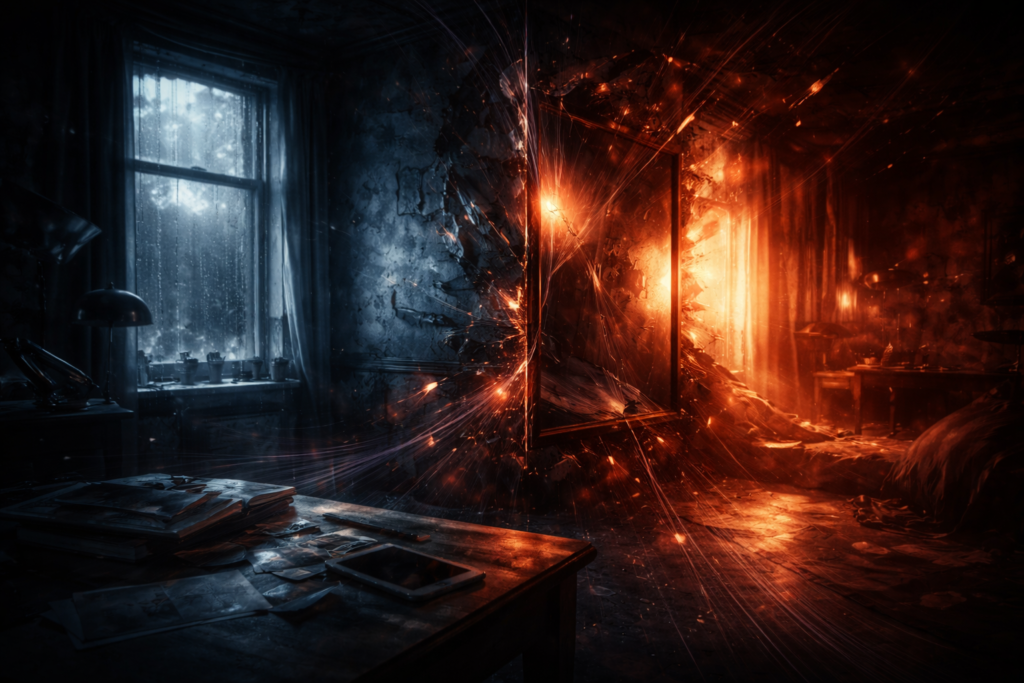
This transforms the film from objective storytelling into subjective experience.
This idea builds directly from Article 3, where cinematic writing replaces explanation with imagery.
Because in psychological thrillers:
Emotion is not explained. It is seen.
In Yohana’s World, the environment reacts too, based on her psychological state.
During moments of strain:
- Walls break and spill out words
- Shadows stretch unnaturally
- Objects shift subtly out of alignment
These visuals are not meant for some stylistic flourish. They are the manifestations of Yohana’s internal conflict.
Her psychology becomes the film’s visual language.
Behaviour shapes rhythm
Pacing is often treated as an editorial decision. That is what we learn at Film schools.
But specifically in psychological thriller filmmaking, pacing begins with behavior.
How a character behaves under pressure determines:
- Scene duration
- Dialogue rhythm
- Movement speed
- Emotional intensity
A hesitant character slows down scenes.
An impulsive character accelerates them.
A conflicted character creates uneven pace.
This concept connects directly to Article 1’s idea of thinking like a filmmaker and Article 2’s focus on tension framework.
Remember pacing, in a psychological thriller filmmaking context, is behavioral.

Yohana’s behavioral pattern is of resistance.
She withdraws. She hesitates. And she delays.
These behaviors stretch the scenes.
Moments that could resolve quickly are prolonged.
Silence expands. Tension accumulates. Her behavior becomes the film’s pacing.
It is all an organic pacing approach.
The system is circular
Here is the most important realization in psychological thriller filmmaking:
Nothing operates independently.
- Character influences suspense.
- Suspense influences pacing.
- Pacing influences visuals.
- Visuals reinforce character.
It is a loop.
A system.
If one element is weak, the entire system destabilizes.
But when aligned, the film becomes immersive.
This is what separates technically correct scripts from cinematic ones.
Because a technically correct script may have:
- Structure
- Dialogue
- Character arcs
But without integration, it does not feel like a film.
Psychological thriller filmmaking demands integration.

In Yohana’s World, this system is intentionally circular.
Yohana’s internal conflict shapes visual distortions. Those distortions reinforce her psychological instability. Her instability affects her behavior. Her behavior influences pacing.
Pacing affects suspense. And the cycle continues.
Nothing exists in isolation.
Everything feeds everything else.
From script to cinematic blueprint
Most screenplays are documents.
Some become blueprints.
Very few become systems.
Psychological thriller filmmaking requires thinking beyond the page.
It requires designing:
- Character psychology
- Visual language
- Spatial tension
- Behavioral rhythm
- Suspense architecture
All at once.
Filmmaking, before production begins.
As discussed across Articles 1 through 4, the most powerful scripts are already cinematic.

Yohana’s World, from the start has been designed as a cinematic system.
Every scene carries:
- Psychological intent
- Visual implication
- Behavioral rhythm
- Suspense architecture
The film already exists.
As an integrated experience.
I personally believe that this is the true goal of psychological thriller filmmaking.
Final reflection: The film exists before it is shot
At its highest level, psychological thriller filmmaking is about designing a system where:
- Character creates pressure.
- Pressure creates suspense.
- Suspense shapes pacing.
- Pacing influences visuals.
- Visuals reflect psychology.
And all of it loops back into the character.
When this happens, the screenplay stops feeling like writing.
It begins to feel like a film.
And the audience is ready to experience it.
Psychological thriller filmmaking reaches its highest level when character, suspense, visual language and pacing operate as a unified system. When these elements are designed together, the film becomes immersive, intentional and structurally powerful rather than reactive.
A cinematic invitation
So, if you are serious about psychological thriller filmmaking at a cinematic level, Yohana’s World offers a complete, integrated system.
The entire package includes:
• Scene-by-scene breakdown
• Psychological character architecture
• Visual language system
• Suspense design framework
• Behavioral rhythm mapping
I present to you a fully engineered cinematic blueprint.
The entire package is available for direct acquisition at $555,000.
For producers, studios and visionary investors seeking a psychological thriller designed at system level, this is a story waiting to be executed.
Register your interest today on Yohana’s World official website.
You are most welcome to read the first 21 pages of the screenplay here.
As a closing remark, all I want to say is that in true psychological thriller filmmaking, the film begins long before the camera rolls.
And Yohana’s World is already alive.