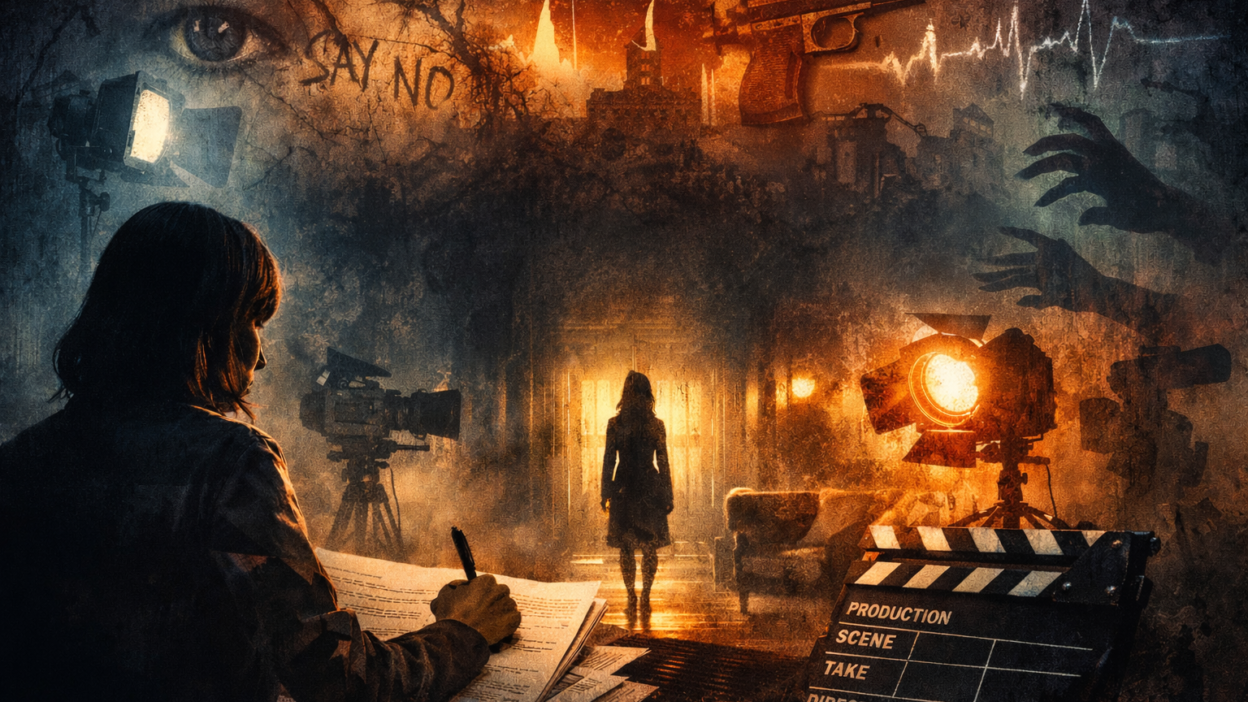
Psychological thriller screenwriting is more about designing psychological tension that can be filmed, rather than merely writing fear on page.
We writers (perhaps out of ignorance) approach thrillers as literary exercises. We describe emotions. We explain motives. We even structure beats.
But cinema does not photograph explanations.
It photographs behavior. Movement. Space. Distortion.
I consider myself a writer who wants to direct. Someone who sees story primarily as cinema. And that perspective has shaped how I approach psychological thriller screenwriting, particularly in my screenplay Yohana’s World.
What frustrates me about mainstream screenwriting advice is simple: too many rules, not enough psychological depth.
- Three acts.
- Ten beats.
- Inciting incident by page twelve.
- Avoid surrealism.
- Never write what can’t be filmed.
But what if the psyche itself must be filmed?
Psychological thrillers demand something different. They demand that interior conflict becomes visible.
If we writers have to master psychological thriller screenwriting, we need to begin thinking like a filmmaker.
Below are the principles that guide my process.
Screenwriting is pre-visualization, not prose
At its core, psychological thriller screenwriting is architectural.
A screenplay is not literature. It is a cinematic blueprint.
When you write like a filmmaker, you are not asking:
“How does it feel?”
You are asking:
- Where is the character placed in the frame?
- What dominates the foreground?
- What remains in shadow?
- What is withheld from the audience?
- What moves first: the body or the environment?
Thrillers rely on anticipation. Anticipation relies on visual design.
If our scripts cannot be imagined as images, it is incomplete.
Yohana’s World does not begin with exposition. It begins with a wounded hand reaching for a phone on a deserted road. A shadow intrudes. A foot crushes the device. Gunshots rupture the silence around.
There is no explanation.
Only staging.
Road.
Hand.
Shadow.
Nothingness.
This is psychological thriller screenwriting built on image logic, not literary explanation.
Because before I write dialogue, I should see the frame.
Writing psychological physics, not emotional labels
It is common knowledge that most of us begin by naming emotions.
“She is scared.”
“He feels conflicted.”
“She is overwhelmed.”
I myself have and as a writer, we have the liberty. No one is going to read our first drafts.
But cinema cannot photograph “conflicted.”
It can photograph shaking hands. Flickering lights. Warped reflections. Objects behaving unnaturally.
In psychological thriller screenwriting, internal states must affect external reality.
Think of it as psychological physics.

If a character is unstable, the world should not remain stable.
If guilt consumes someone, something in the frame should break.
In my previous Post, I have explored how fragile the mind of a psychological thriller character is and should be.
See, you do not explain mental strain. You design its consequences.
When Yohana slaps herself inside a moving car, the environment wobbles. Buildings distort. Reality bends.
When she resists taking a case tied to her past, words like “SAY NO” and “DENY” carve themselves into walls as if the world is pressuring her to rescue herself.
If you believe this is fantasy, think again.
Yohana’s mind projects conflict rather than narrate it.
This is psychological thriller screenwriting operating at a cinematic level.
Blocking the scene before writing Dialogue
In my most humble opinion, directors think spatially.
Power is visual before it is verbal.
Who stands?
Who sits?
Who leans forward?
Who watches from the background?
Who interrupts the geometry?
Position equals psychology.
In psychological thriller screenwriting, blocking becomes subtext.
Distance creates tension.
Stillness creates pressure.
Movement reveals motive.
If, as a writer we write dialogue first and staging later, we are thinking like a novelist and not a filmmaker.
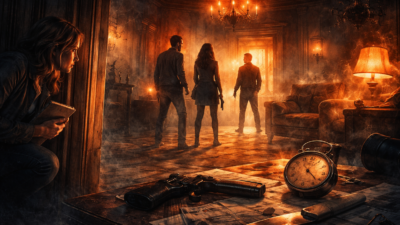
In the café scene at the beginning of Yohana’s World screenplay, Ava leans forward. Stephen checks his watch. Yohana remains composed. Zuri and Ayden stand behind her like extensions of her psyche. A chandelier looms overhead.
No one says, “There is tension.”
The tension is staged.
Later, in the living room confrontation, characters cluster, clash and escalate physically while Yohana remains seated, absorbing the chaos.
Blocking communicates more than dialogue ever could.
That is filmmaker thinking embedded into psychological thriller screenwriting.
Dialogue should trigger, not explain
Exposition weakens suspense.
Psychological thriller screenwriting requires dialogue that triggers decisions, not clarifies plot.
A powerful line should:
- Reframe a theme.
- Activate buried trauma.
- Shift psychological direction.
- Reveal that which has broken down.
If dialogue merely explains what we already see, it is unnecessary.
On Page 19 of the screenplay, Frank’s shadow joke appears innocent:
“What did a Woman’s shadow say to her?”
The answer:
“I will never forgive you. You have always kept me in the dark.”
Shadow. Suppression. Guilt. Darkness.
The line cracks open Yohana’s resistance and becomes the pivot toward accepting the case.
The dialogue activates Yohana’s trauma.
That is psychological thriller screenwriting at work.
Objects must carry psychological weight
In strong psychological thriller screenwriting, objects are emotional anchors.
They behave like memory vessels, and cannot be considered a mere prop.
- A diary.
- A photograph.
- A broken phone.
- A blood-stained garment.
If removed, the emotional architecture should collapse.
As a filmmaker-writer, we must ask:
What object carries my protagonist’s internal gravity?
The purple diary in Yohana’s World is the best example here.
It is a stabilizer. A trigger. A vault of suppressed memory.
When conflict rises, Yohana clutches it harder. When decisions loom, it anchors her.
The diary replaces monologue.
That is cinematic efficiency.
That is psychological thriller screenwriting thinking in objects.
Breaking rules when psychology demands it
Yes, there are rules in screenwriting. Reddit talks more on it and here are some that I have read in books and from experts whom I have studied:
- Avoid camera directions.
- Avoid unfilmable thoughts.
- Keep description lean.
- Avoid surrealism unless justified.
But here is a provocative truth:
Rules exist to prevent incompetence, not to suppress vision.
If your psychological logic demands that chalk outlines move, shadows crawl, vegetables cut themselves or walls split open, and if it serves theme, then write it.
Clarity matters more than conformity.
Cinema evolves because someone breaks a rule intentionally.
In Yohana’s World, chalk outlines indeed move. Words carve into walls. A knife cuts vegetables by itself. A puppy speaks in a human voice.
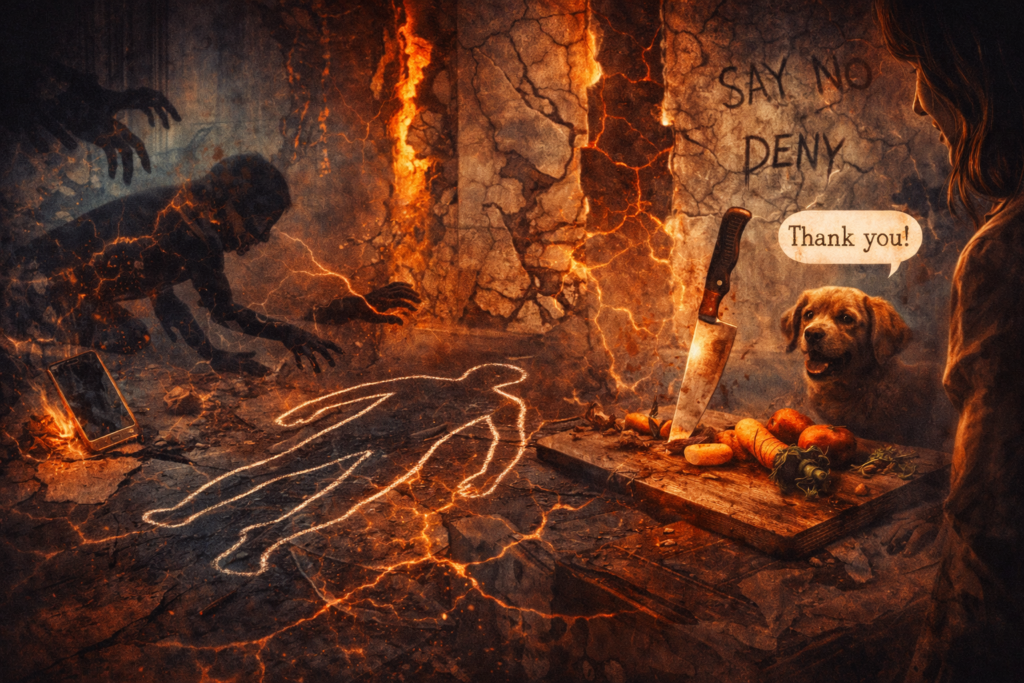
By traditional standards, these might be flagged as “too surreal.”
But within Yohana’s subjective reality, they are logical.
Psychological thriller screenwriting must sometimes bend realism to reveal truth.
If I had obeyed rigid advice, I would have amputated the soul of my screenplay.
And psychological thrillers without soul are just crime dramas.
Interior conflict is the true Plot
In conventional thrillers, the plot is external.
- Who committed the crime?
- Who escapes?
- Who wins?
In psychological thriller screenwriting, the real plot is internal.
- Will the protagonist confront truth?
- Will they forgive?
- Will they accept guilt?
- Will they break completely?
The murder is the surface story. The psyche is the real battlefield.
If we as writers, are not designing scenes to reflect that internal war visually, we are missing the genre’s core.
In Yohana’s World, there is a murder investigation.
But the real story is whether Yohana can return to Los Angeles: a city bound to her trauma and face what she has buried there.
The external case creates pressure. Her internal conflict creates suspense.
That distinction defines psychological thriller screenwriting.
Psychological Thriller screenwriting as cinematic design
Psychological thriller screenwriting is not about writing fear.
It is about constructing cinematic tension through:
- Visual psychology
- Spatial blocking
- Environmental distortion
- Symbolic objects
- Triggering dialogue
- Rule-breaking when necessary
If you think like a filmmaker while writing, your script will stop being a document.
It becomes a world.
And worlds are not read. They are experienced.
A confident invitation
This is for you.
If you are serious about psychological thriller screenwriting at a cinematic level: not formulaic, not mechanical, but psychologically layered and visually designed, then Yohana’s World is available for direct acquisition.
This complete cinematic blueprint includes:
- 118-page complete screenplay
- Scene-by-scene breakdown
- Psychological character architecture
- Visual language framework
- Symbolic motif system
- Blocking logic and spatial tension design
- Subjective reality mechanics
The full package is available for direct sale at $555,000.
For story collectors, producers, studios and visionary investors seeking a psychologically driven thriller that already thinks like a film, this is an opportunity to invest in a fully realized cinematic world.
Visit : Yohana’s World to register your interest.
Because when psychological thriller screenwriting is done right, it makes the world tremble.
And Yohana’s World is ready to be filmed.