
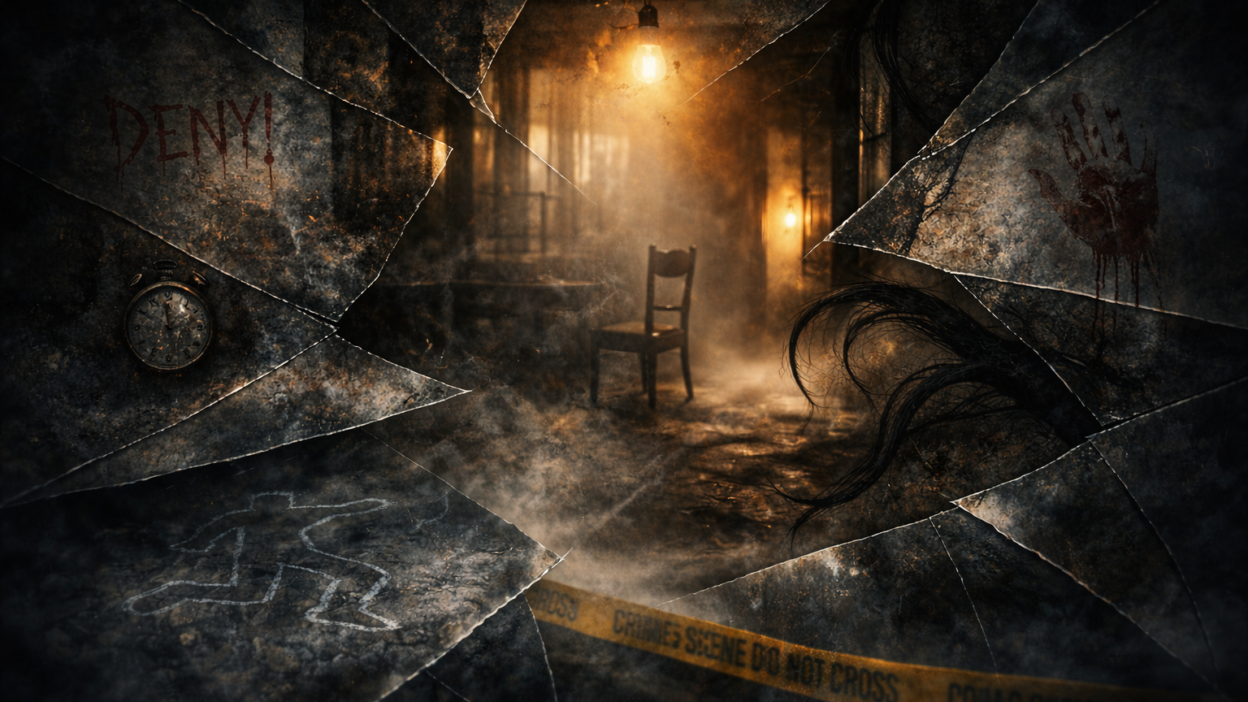
Learn how psychological thriller tension is built through ambiguity, dual realities and narrative uncertainty that destabilizes the viewer.
As discussed in my article on Psychological Thriller Craft, the foundation of a powerful psychological thriller is breaking from within. A psychological wound destabilizes the protagonist long before the plot begins to unfold.
But breaking alone does not create tension.
Psychological Thriller Tension emerges when that break begins to distort the character’s perception of reality and when the audience begins to doubt what they are seeing.
This is where psychological thrillers differ from nearly every other storytelling form. Action films generate excitement through spectacle. Crime thrillers generate suspense through danger. Mysteries generate curiosity through unanswered questions.
Psychological thrillers generate tension through interpretive instability.
The audience is constantly negotiating between possible meanings of the events happening. Every action, every clue, every visual detail becomes suspect. The viewer begins to wonder not simply what will happen next, but whether what just happened was real at all.
In advanced storytelling, this uncertainty becomes structural. Writers construct a framework of uncertainty that runs through the entire narrative.
When executed well, psychological thriller tension builds gradually as the audience loses confidence in the stability of the world they are watching.
My article explores how this framework works: how ambiguity can be constructed without confusing the viewer, how the Two Realities Technique deepens engagement and how narrative questions can destabilize perception while still maintaining emotional clarity.
When writers learn to design this framework intentionally, tension becomes inevitable.
Psychological thriller craft relies on controlled uncertainty
Traditional thrillers, as always depend on escalating danger.
- A bomb might explode.
- A killer might strike again.
- A secret might be revealed at the worst possible moment.
In these stories, tension arises from external risk.
Psychological thriller tension filled stories operate on the mind level. Instead of escalating danger, they escalate uncertainty. The viewer becomes uneasy not because of what might happen next, but because of uncertainty about what is already happening.
This shift transforms the entire narrative experience.
In conventional thrillers, viewers observe events and wait for outcomes. In psychological thrillers, viewers actively interpret events while questioning their reliability.
This distinction is fundamental to psychological thriller tension.
The audience must constantly evaluate two possibilities:
- What appears to be happening in the physical world.
- What the protagonist perceives to be happening.
The tension emerges from the gap between those interpretations.
However, writers must control this uncertainty carefully.
Too much clarity removes psychological tension. If the audience completely understands the reality of the situation, the story becomes predictable.
But too much ambiguity can destroy engagement. If viewers feel completely lost, they stop trying to interpret the narrative and instead focus on their popcorns.
The craft really lies in balancing those forces.
Psychological thriller tension thrives in the narrow space between certainty and confusion. The audience must feel slightly unstable, but never disconnected.
When controlled properly, uncertainty becomes an engine that drives the entire story.
In Yohana’s World, uncertainty appears early and consistently.
Yohana is introduced as a capable investigator. She pursues suspects through crowded streets, interrogates criminals and approaches crime scenes with confidence.
From an external perspective, she appears composed and competent.
Yet subtle distortions begin appearing in her perception.
At one moment, a puppy she rescues suddenly looks directly at her and speaks in a human voice.
The moment lasts only briefly, but it creates a profound shift in the viewer’s interpretation of the world.
Did the puppy actually speak?
Is the moment symbolic?
Or is Yohana’s mind translating an emotional experience into something visual?
The story deliberately avoids answering these questions immediately. Instead, the uncertainty lingers.
Later, words appear on walls instructing her to “SAY NO!” and “DENY!”
Again, the environment appears to respond to Yohana’s internal struggle.
From the viewer’s perspective, these moments create a subtle but growing instability. Reality seems to shift slightly depending on Yohana’s emotional state.
This is precisely how psychological thriller tension is constructed. The audience experiences the same perceptual instability as the protagonist.
And with every new moment of instability, the narrative grows more unsettling.
The Two Realities Technique
This can be one of the most powerful tools in psychological thriller tension craft and it is called the Two Realities Technique.
A psychological thriller tension filled story must simultaneously present two different interpretations of the same moment:
- Objective Reality: the world as it physically exists.
- Subjective Reality: the world as the protagonist experiences it.
The viewer must witness both layers.
But crucially, the viewer should not immediately determine which one is trustworthy.
This dual-layer storytelling accomplishes several things.
First, it increases engagement. The audience actively participates in interpreting events.
Second, it deepens psychological immersion. Viewers do not simply watch the protagonist’s instability but they experience it.
Third, it allows psychological thriller tension to accumulate without relying on physical danger or external action.
Every scene contains the possibility of misinterpretation.
When these two realities diverge, the gap between them becomes the source of suspense.
Yohana’s World repeatedly uses this technique to destabilize perception.
One striking example occurs at a crime scene on Page 20 where Yohana examines a chalk outline marking the victim’s body.
To outside observers, the outline is simply evidence : a static mark indicating where the victim fell.
But to Yohana, the outline appears to move. It stretches outward, reaching toward something unseen before settling back into place.

The moment is visually subtle yet psychologically powerful.
Is the outline truly moving?
Or is Yohana reconstructing the crime in her mind, projecting her intuition onto the physical environment?
The audience cannot immediately answer that question.
The scene operates on both levels simultaneously.
On one level, the outline remains ordinary evidence. On another level, it becomes a symbolic representation of Yohana’s investigative instinct.
The two realities coexist.
And the tension arises from the viewer’s inability to determine which reality should be trusted.
This technique allows psychological thriller tension to emerge naturally from perception itself rather than from dramatic action.
Ambiguity without confusion
Ambiguity is essential to psychological thriller tension filled stories, but it must be carefully controlled.
Many writers tend to misunderstand ambiguity and assume it means withholding information.
In reality, ambiguity works slightly differently.
The audience should see the same evidence as the protagonist. What remains uncertain is not the evidence itself, but its meaning.
The viewer understands what occurred in a scene.
What they cannot determine is how to interpret it.
This distinction is critical for sustaining psychological thriller tension.
Confusion occurs when viewers lack the information necessary to follow the story.
Ambiguity occurs when viewers possess the information but cannot determine its correct interpretation.
Psychological thrillers thrive on ambiguity because it invites the audience into the interpretive process.
However, ambiguity must always be anchored by emotional clarity.
Even if viewers question what they see, they must understand why the protagonist reacts emotionally.
Emotion becomes the stabilizing force within an unstable reality.
Without that anchor, ambiguity collapses into chaos.

In my screenplay Yohana’s World, emotional clarity remains constant even when perception shifts.
A powerful example occurs when teenager Michelle begs Yohana to help investigate her mother’s murder on Page 17 of the screenplay.
Michelle’s desperation is unmistakable. Her plea is genuine, her grief overwhelming.
Yet in that moment, Yohana begins seeing a different girl in Michelle’s place. A blood-covered figure from her past.
Visually, the scene becomes ambiguous.
Is the girl real?
Is she a memory?
Is she a projection of Yohana’s trauma?
The audience cannot know for certain.
But the emotional logic remains clear.
Yohana’s hesitation stems from unresolved abandonment and guilt. Her reaction is psychologically consistent even if the imagery surrounding her becomes uncertain.
This balance allows ambiguity to deepen the narrative rather than disrupt it.
The audience may question reality but they trust the emotional truth guiding the character.
And that trust sustains psychological thriller tension across the narrative.
Balancing misdirection with emotional clarity
Misdirection is a familiar tool in thriller storytelling. However, in psychological thriller craft, misdirection operates differently than it does in traditional mysteries.
In a classic mystery, misdirection hides information. The audience is intentionally kept from seeing certain clues until the moment of revelation.
Psychological thrillers rarely hide information.
Instead, they present information in ways that encourage the audience to interpret it incorrectly.
Under no circumstance is the viewer missing clues. No no. The clues are visible from the beginning. What changes is the lens through which the audience interprets them.
This approach strengthens psychological thriller tension because it invites viewers to actively participate in the narrative.
They attempt to construct meaning from the evidence presented, but the evidence is filtered through the protagonist’s unstable perception.
However, misdirection must be carefully balanced with emotional clarity.
If the story later reveals that a character’s behavior was inconsistent with their emotional reality, the audience will feel cheated. The narrative collapses because the character no longer feels psychologically authentic.
Psychological thriller misdirection must therefore follow one essential rule:
The audience may misunderstand events, but the character’s emotional behavior must always remain truthful.
When misdirection works this way, the eventual revelations feel inevitable rather than manipulative.
The viewer realizes they were not deceived.
They simply interpreted the story through the wrong psychological lens.
In Yohana’s World, misdirection emerges through the presence of the characters surrounding Yohana.
Throughout the story, figures like Zuri, Ayden, Frank, Samuel and Alice interact with her as though they are independent individuals. They offer advice, disagree with her decisions, argue among themselves and influence the direction of her investigation.
To the audience, these interactions initially appear ordinary.
They seem like a support system. Friends or companions helping Yohana navigate the emotional pressure of a murder investigation.
Yet their behavior gradually reveals something deeper.
Each character reflects a different emotional response to Yohana’s psychological conflict.
Zuri represents control and discipline.
Ayden embodies humor and deflection.
Frank symbolizes innocence and emotional refuge.
These figures behave consistently with their roles and their interactions with Yohana remain emotionally believable throughout the story.
This is where the misdirection operates.
The audience initially interprets these characters as external individuals.
But the narrative structure subtly suggests that they may also represent extensions of Yohana’s broken internal world.
The story never explicitly forces that interpretation early on.
Instead, it allows the viewer to continue questioning what is real and what is perceived.
This ambiguity preserves emotional integrity while deepening psychological thriller tension.
The characters remain psychologically authentic within Yohana’s emotional landscape, even as the audience begins to question the nature of their existence.
And because their behavior always aligns with Yohana’s emotional state, the misdirection never feels artificial.
It simply reveals how easily perception can reshape reality.
Designing narrative questions that destabilize the viewer
Every psychological thriller must establish destabilizing questions early in the narrative. It is crucial.
Traditional thrillers typically revolve around a single mystery:
“Who committed the crime?”
Psychological thrillers introduce more complex questions.
- Can the protagonist trust their perception?
- Is the threat external or internal?
- Is the investigation revealing the truth or protecting the character from it?
These questions stretch across the entire narrative.
They transform the investigation into psychological excavation.
The audience seeks answers about the protagonist’s mind.
The more answers revealed, the story becomes increasingly unstable.
Uncertainty spreads across every aspect of the narrative.
This is the framework of psychological thriller tension.
The viewer is trying to understand whether the world itself is trustworthy.

By the time Yohana begins investigating Nicole’s murder, the audience is already grappling with multiple questions.
- Are the voices she hears real?
- Are the companions around her independent people or fragments of her psyche?
- Is the crime investigation bringing her closer to the truth or forcing her to confront memories she has suppressed?
Each clue deepens the external mystery.
But it also deepens the internal one.
The narrative operates on two investigative tracks:
The investigation of the murder. And the investigation of Yohana’s psychological reality.
These two investigations begin to intersect.
As they do, psychological thriller tension intensifies. The viewer realizes that solving the crime may require confronting something far more unsettling: the protagonist’s own broken perception of life.
The investigation becomes less about discovering a killer and more about uncovering the truth buried inside Yohana’s mind.
And that transformation destabilizes every moment of the story. And since it is a psychological thriller, it must.
The Discipline of uncertainty
Psychological thriller tension stories rarely succeed because they surprise the audience.
They succeed because they destabilize them.
When viewers begin questioning the reliability of perception, every scene becomes uncertain.
Every image becomes a suspect.
Every emotional reaction becomes a potential clue.
But this instability must be constructed with discipline.
Writers must carefully design the framework of uncertainty so that ambiguity deepens engagement rather than creating confusion.
When done correctly, psychological thriller tension emerges organically from the act of perception.
The viewer begins to doubt what they see.
And once that doubt takes hold, tension becomes unavoidable.
Yohana’s World, a psychological thriller tension filled story is available for direct acquisition at $555,000
Includes:
• Complete 118 page screenplay
• Scene-by-scene narrative architecture
• Character psychology profiles
• Visual language framework
• Thematic and symbolic design documents
• Long-term franchise scalability analysis
I present to you, a psychologically engineered narrative IP built on perception, ambiguity and controlled uncertainty.
For producers and investors seeking a layered psychological thriller tension filled story with enduring narrative potential:
Yohana’s World is ready.
Register your interest on Yohana’s World official website.