
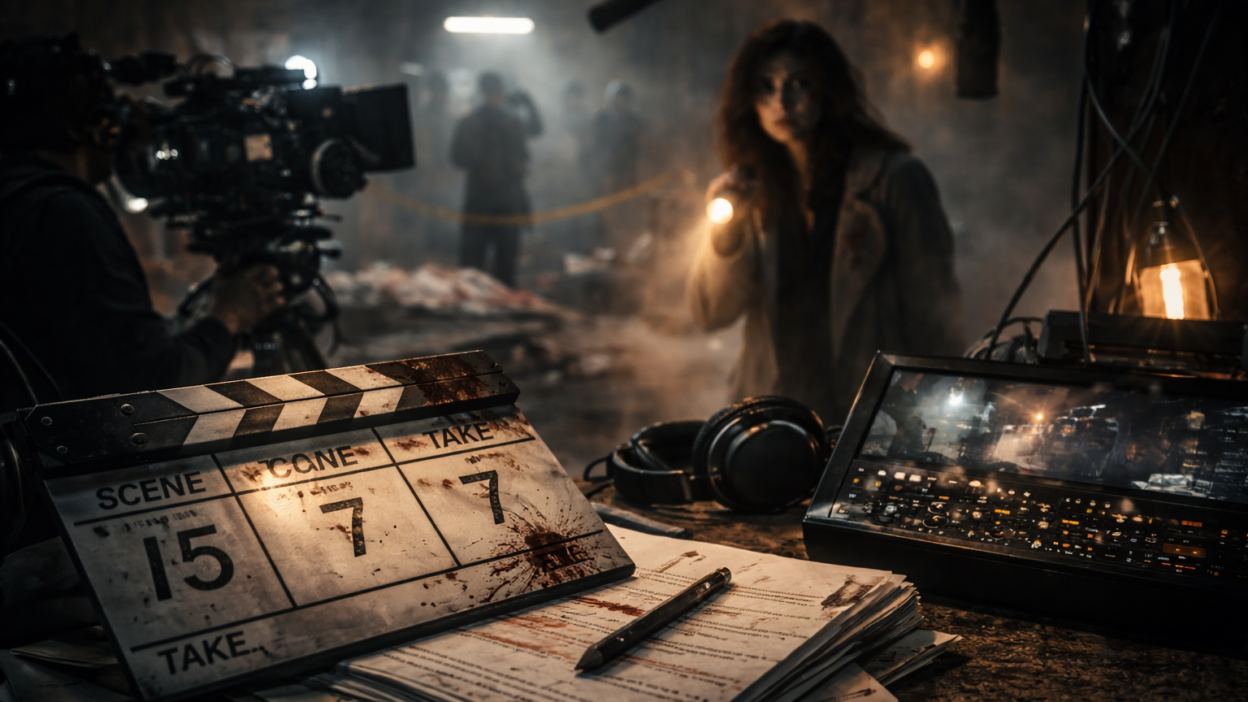
Thriller filmmaking techniques are often discussed through the lens of writers and directors. Screenwriting manuals analyse tension through story beats, while directing guides explore visual suspense through framing and editing. Yet an equally powerful influence over tension often remains understated: the Producer.
In psychological thrillers, producers do far more than finance or coordinate a production. They quietly shape the structural conditions that determine how psychological pressure unfolds on screen. Through choices about pacing, casting philosophy, location psychology, scene coverage and post-production rhythm, producers actively influence how an audience experiences suspense.
Understanding thriller filmmaking techniques from a producing perspective reveals something essential about the genre.
Tension is engineered through production strategy too. The way a film is scheduled, cast, shot and assembled also determines whether suspense becomes suffocating or evaporates entirely.
My article explores how producers contribute to creating this tension. By examining the strategic decisions behind pacing, coverage, casting, environment, budget discipline and editorial rhythm, I aim to uncover how producers help transform psychological thrillers from scripts into visceral audience experiences.
The Producer as the maker of Psychological Tension
When discussing tension in cinema, the spotlight typically falls on the writer’s structure or the director’s visual style. However, many of the most important thriller filmmaking techniques originate before a camera even rolls.
Producers function as makers of the filmmaking environment. They establish the operational framework that allows psychological pressure to flourish. Every key decision: from the number of shooting days to the choice of locations, affects how tension ultimately manifests on screen. Must be hard to believe, but keep on going.
For example, consider the delicate pacing required in psychological thrillers. A scene designed to evoke unease often depends on lingering moments: a character hesitating before opening a door, a subtle shift in body language, a slow realization that something is wrong. These moments demand time during production. If the schedule is compressed or the coverage insufficient, the resulting footage cannot sustain the intended tension.
This is why many successful psychological thrillers rely on producers who understand the craft implications of logistical decisions. By recognizing how production strategy intersects with storytelling, producers help ensure that suspense remains intact from script to screen.
In other words,
Tension is protected through thoughtful production design.
Producers who understand advanced thriller filmmaking techniques know that every logistical choice contributes to the audience’s emotional experience.
In Yohana’s World, psychological tension emerges from the instability of perception. Yohana navigates a world where imagination, trauma and reality constantly overlap. Scenes often depend on pauses and subtle environmental cues rather than overt action.
For a film structured around psychological pressure, production must protect these fragile moments. The pacing of scenes, the framing of environments and the performance rhythms of actors all depend on strategic producing decisions.
This is where understanding thriller filmmaking techniques becomes crucial. If the production environment rushes these scenes, the tension will dissolve. If the coverage is limited, editors will lose the ability to sculpt suspense later.
The producer’s role, therefore, in my opinion must be one of guardianship, ensuring that the structural conditions for tension remain intact throughout the filmmaking process.
Pacing begins with Scheduling
Among the most underestimated thriller filmmaking techniques is the relationship between pacing and production scheduling.
While pacing is often associated with editing, its foundations are laid during production. The rhythm of a film depends heavily on how scenes are scheduled and executed.
Producers determine:
• the number of shooting days allocated to key scenes
• the grouping of emotionally intense sequences
• the energy cycles of performers
• the continuity of environments and lighting
These factors directly influence how tension is captured.
When scenes are rushed due to scheduling pressure, the result is urgency rather than suspense. Urgency may work for action cinema, but psychological thrillers require a different emotional tempo. Suspense grows through hesitation and subtle shifts in behavior.
Effective thriller filmmaking techniques therefore involve protecting the breathing room necessary for tension to unfold. A producer who understands pacing will schedule key scenes with enough flexibility for directors and actors to explore nuance rather than rush through performance beats.
The difference may appear subtle on paper, but on screen it becomes the difference between a scene that feels tense and one that feels hurried.
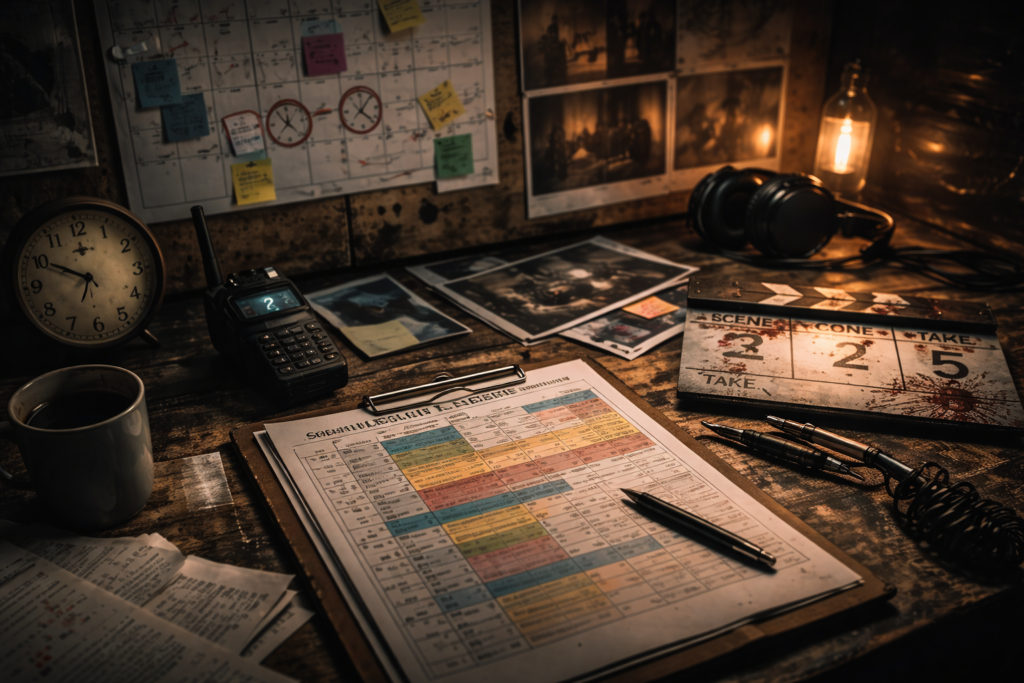
The narrative structure of Yohana’s World relies heavily on psychological recognition. Moments of realization like when the protagonist notices something slightly out of place, form the backbone of the film’s suspense.
These moments require careful pacing during production. Actors must have time to inhabit the emotional space of the scene. The camera must observe the subtle shifts in expression and movement that signal the presence of deeper tension.
Scheduling decisions therefore become critical here. Protecting these scenes ensures that the film’s psychological tempo remains intact. This illustrates how thriller filmmaking techniques extend beyond creative choices and into logistical planning as well.
Scene Coverage as a Psychological Weapon
Scene coverage is another area where producers directly influence thriller filmmaking. Coverage refers to the range of camera angles and shot variations captured during production.
In psychological thrillers, coverage serves a strategic purpose: it allows editors to manipulate tension during post-production.
A scene may require:
• reaction shots revealing subtle emotional shifts
• environmental inserts that amplify unease
• slow push-ins or reframing moments
• alternative perspectives that alter audience interpretation
Without adequate coverage, the editor’s ability to sculpt tension becomes limited. Producers who prioritize thoughtful coverage enable filmmakers to refine suspense later in the editing room.
Strategic coverage transforms raw footage into flexible storytelling material. It allows editors to stretch moments, compress time or redirect attention—all key thriller filmmaking techniques that influence how an audience experiences suspense.
In Yohana’s World, perception frequently shifts between objective reality and subjective imagination. Capturing these transitions requires coverage that supports multiple interpretive possibilities.
Certain scenes may be edited to emphasize reality in one moment and hallucination in another. This flexibility depends entirely on how the scene was captured during production.
By ensuring that coverage accounts for these variations, producers help protect the film’s psychological ambiguity. In doing so, they reinforce one of the most powerful thriller filmmaking techniques: the manipulation of audience perception.
Casting Philosophy and Psychological Pressure
Casting is perhaps one of the most underestimated components of thriller filmmaking. While spectacle-driven films rely heavily on physical action, psychological thrillers depend on emotional gravity.
Actors must be capable of conveying tension through minimal movement. Micro-expressions, subtle hesitations and silent emotional shifts often communicate more suspense than dialogue.
This requires performers who can sustain psychological intensity even during stillness. Producers therefore play a crucial role in selecting actors whose presence naturally generates tension.
Casting decisions shape the emotional bandwidth of the film. A performer who can communicate internal conflict with subtlety allows tension to build organically. Conversely, casting choices that lack emotional depth may force filmmakers to compensate through excessive visual or auditory effects.
In psychological thrillers, casting becomes one of the most powerful thriller filmmaking task available to producers.

The central character of Yohana’s World embodies multiple emotional contradictions. She must simultaneously project determination, vulnerability and instability.
Casting for such a role requires careful consideration. The performer must carry psychological complexity while maintaining audience empathy.
When the right actor occupies the role, tension arises naturally from performance rather than visuals. This reinforces the film’s reliance on disciplined thriller filmmaking techniques centered around character psychology.
Location Psychology
Locations in psychological thrillers function as more than backdrops. They act as emotional amplifiers that reinforce narrative tension.
Producers must evaluate locations through a psychological lens, considering factors such as:
• spatial confinement
• creation ambiguity
• lighting adaptability
• acoustic atmosphere
Certain environments naturally generate unease. Long corridors, empty rooms and transitional spaces create psychological pressure by emphasizing isolation and uncertainty.
Choosing locations with these qualities allows filmmakers to enhance tension without increasing production costs. This is another example of how thriller filmmaking can be achieved through strategic producing decisions rather than expensive visual effects.
In Yohana’s World, environments mirror the protagonist’s psychological state. Spaces are selected for their emotional neutrality, allowing tension to emerge gradually rather than being imposed artificially.
This approach reinforces the film’s reliance on subtle thriller filmmaking tasks that prioritize atmosphere over visual-heavy scenarios.
Micro-budget decisions that protect tension
Budget discipline plays a crucial role in psychological thrillers. While large-scale films can be impressive, excessive visual effects often distract from emotional focus.
Producers who understand thriller filmmaking techniques know that certain areas yield greater returns for tension-building:
• art direction
• lighting design
• sound design
• rehearsal time for actors
These investments amplify psychological pressure without inflating the production budget.
Sound design, for example, can subtly alter the audience’s emotional state through environmental noise or distant echoes. Lighting design can obscure visual information, encouraging viewers to imagine what lies beyond the frame.
Strategic producers allocate resources to these elements rather than prioritizing unnecessary display of lights and sounds.

The tension in Yohana’s World depends on internal disturbance rather than physical chaos. Budget decisions therefore prioritize elements that strengthen psychological immersion.
Atmospheric lighting, symbolic visual motifs and layered sound design all contribute to the story’s emotional texture. These choices demonstrate how a disciplined thriller filmmaking can create powerful tension without excessive expenditure.
Post-production rhythm: Where tension is finalized
Editing is the final stage where all the thriller filmmaking techniques converge. Here, the captured footage transforms into emotional rhythm.
Editors manipulate timing, pacing and visual emphasis to determine how long an audience remains suspended in uncertainty. Producers influence this process by supporting editorial strategies that prioritize psychological tension.
Test screenings, pacing adjustments and collaborative editing sessions all shape the final rhythm of the film.
A key principle in psychological thrillers is resisting the urge to resolve tension too quickly. Allowing moments of ambiguity to linger creates discomfort that keeps audiences engaged.
In Yohana’s World, many scenes conclude without complete resolution. Questions remain unanswered, forcing the audience to inhabit the protagonist’s psychological uncertainty.
Preserving this ambiguity requires editorial restraint. Producers who understand thriller filmmaking recognize that tension thrives in unanswered questions.
Producer Takeaway
Designing tension is not the exclusive domain of writers or directors. Producers shape the conditions under which suspense can exist.
Through decisions involving scheduling, coverage, casting, location selection, budget allocation and editorial philosophy, producers become active participants in crafting psychological pressure.
When these elements align, tension becomes structural rather than accidental. This is the essence of sophisticated thriller filmmaking: a carefully orchestrated system where every production decision contributes to the audience’s emotional experience.
The creative framework behind Yohana’s World is built upon the disciplined application of these thriller filmmaking techniques.
The screenplay integrates:
• psychologically layered characters
• symbolic visual language
• tension-driven scene construction
• environments designed to amplify uncertainty
Together, these elements create a narrative framework where suspense evolves organically from character and atmosphere.
The complete Yohana’s World package is currently available for acquisition.
$555,000 as Direct Sale
Included:
• Full 118 page Screenplay
• Scene-by-Scene Breakdown
• Character Psychology Profiles
• Visual Language Framework
• Structural Beat Map
For producers seeking a prestige project built on sophisticated thriller filmmaking, Yohana’s World offers a fully engineered narrative ready for development.
Register your interest on Yohana’s World official website.