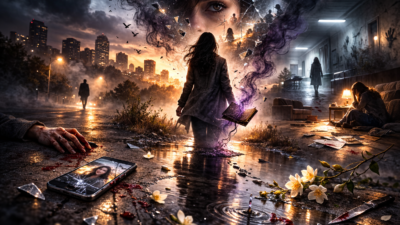
Visual storytelling in film is often described in simple terms: Show, don’t tell.
But in psychological thrillers, this idea evolves into something far more complex and profound. It becomes an invisible language, one that exists beneath dialogue, beneath plot and even beneath conscious thought.
It is a language of perception.
A language made of space, light, framing and movement.
A language that communicates before the audience realizes it is being spoken.
In most films, meaning is delivered through dialogue. Characters explain what they feel. The story progresses through spoken exchanges. The audience listens and understands.
Psychological thrillers take a different path.
They allow meaning to emerge.
They allow the audience to feel first and understand later.
This is where visual storytelling in film becomes powerful. It bypasses logic and moves directly into emotional perception. It allows filmmakers to shape how the audience experiences reality, rather than simply presenting it.
Throughout this series of articles, I have explored the building blocks of this invisible language:
- In Article 1 : Psychological Thriller Visual Language: Seeing the Mind as a cinematic map, we examined how visuals reflect internal states and how perception itself becomes narrative.
- In Article 2 : Psychological Thriller Framing : How space creates Psychological pressure, we explored how framing and spatial design shape tension and emotional imbalance.
- In Article 3 : Cinematic Lighting : Shadows, light and truth, we understood how cinematic lighting reveals, conceals, and manipulates truth.
- In Article 4 : Point of view in Psychological Thriller : When the camera becomes a mind, we saw how perspective transforms the camera into consciousness itself.
This final article is about bringing everything together.
Because visual storytelling in film is a framework in itself.
A framework that shapes perception.
A framework that builds emotion.
A framework that allows cinema to speak without words.
And in Yohana’s World, this system is the foundation.
Visual Language as a framework, not a technique
One of the most common misconceptions about filmmaking is treating visual elements as decoration.
- Cinematography is often reduced to “beautiful shots.”
- Lighting becomes mood.
- Framing becomes composition.
But in psychological thrillers, visual storytelling in film is structural.
It is about how a film thinks.
In traditional filmmaking workflows, different departments often operate independently:
- Cinematography handles visuals
- Production design builds environments
- Editing controls rhythm
- Sound design shapes atmosphere
Each department contributes to the final product, but their work is often layered sequentially.
Psychological thrillers disrupt this separation.
They demand integration.
A narrow hallway can be envisioned as a psychological confinement.
A shadow can become narrative ambiguity.
A slow camera movement has the potential to become emotional pressure.
This is where visual storytelling in film transforms into a unified system.
Every element serves the same purpose: shaping the audience’s perception.
The viewer experiences each of the element collectively.
They feel tension without knowing exactly why.
In Yohana’s World, this integration is intentional from the script level.
Scenes are constructed through:
- spatial imbalance
- controlled visual isolation
- lighting contrast
- perspective-driven framing
Each scene contributes to a larger psychological structure.
The world itself becomes expressive.
A location is never just a location.
It is an extension of a point of view.
This approach ensures that visual storytelling in film is embedded into the DNA of the narrative, rather than applied during production.
The film begins in the visual way.
The audience as interpreter
Psychological thrillers demand something different from their audience.
They provide fragments rather than complete answers.
- Fragments of image.
- Fragments of sound.
- Fragments of emotion.
The audience must assemble meaning from these fragments.
Traditional storytelling, in my study treats the viewer as a passive participant. Information is delivered clearly and the audience follows along.
Psychological thrillers challenge this model.
By withholding explicit explanation and relying on visual cues, they transform the viewer into an active interpreter.
The audience begins to:
- scan the frame for hidden details
- question what they see
- connect visual patterns across scenes
- interpret emotional signals
This process creates deeper engagement.
The story is discovered as the minutes pass by.
This is one of the most powerful aspects of visual storytelling in film : Perception into participation.
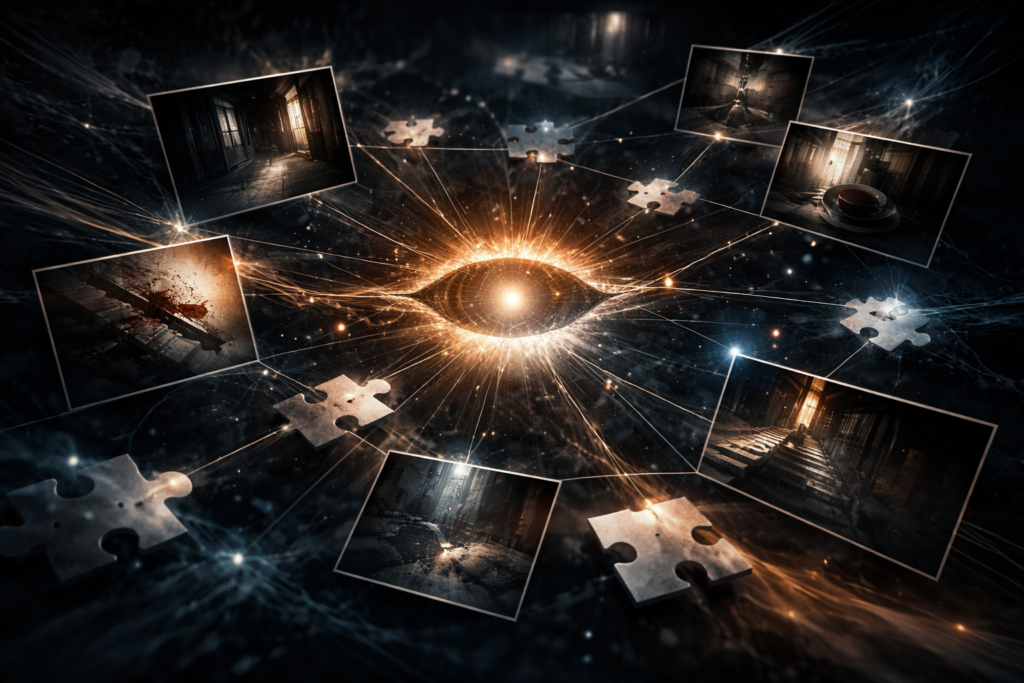
In Yohana’s World, the audience is never given full clarity.
Instead, they are placed inside a visual experience that suggests meaning without confirming it.
A shadow may feel significant.
A space may feel emotionally charged.
A moment of stillness may carry tension.
But nothing is fully explained.
The viewer becomes part of the narrative process.
And in doing so, they begin to experience the same uncertainty that defines her world.
Space, light and perspective : A unified language
Each article in this series has explored a specific element of psychological storytelling.
But their true power lies in how they interact.
Consider a single moment in a psychological thriller.
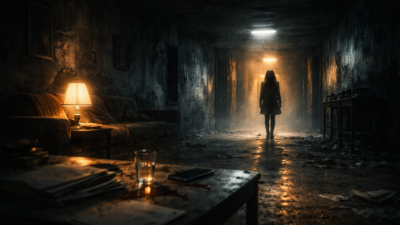
A character stands alone in a dimly lit room.
- The space is vast → isolation
- The lighting is low → concealment
- The camera slowly moves closer → tension
- The frame is slightly off-center → unease
Individually, these elements have meaning.
Together, they create emotion.
This layering is what defines advanced visual storytelling in film.
Meaning does not come from one technique. It emerges from their combination.
This is the difference between style and language.
Style is visible. Language is felt.
In Yohana’s World, scenes are constructed through this layered approach.
No single element dominates.
Instead:
- space creates emotional distance
- light reveals partial truth
- movement builds pressure
- perspective shapes perception
These elements operate simultaneously.
And through this experience the audience receives, the psychological world of the film begins to unfold.
Why this matters for filmmaking?
Understanding visual storytelling in film at this level fundamentally changes how films are created.
When visual language is embedded from the beginning, the screenplay becomes a cinematic blueprint.
It allows:
- directors to understand tone immediately
- cinematographers to design purposeful visuals
- production designers to build meaningful environments
- editors to maintain psychological rhythm
Instead of adding visual style later, the film emerges from it.
This approach leads to stronger cohesion and deeper emotional impact.

Yohana’s World is written on this principle.
The screenplay integrates both narrative and visual design.
Every scene is attempted to have been conceived visually, psychologically and emotionally from the outset.
The film already exists in visual form, before it is produced.
This is the strength of treating visual storytelling in film as a foundational system rather than an enhancement.
The invisible becomes the most powerful
The most powerful aspect of visual language is that it remains invisible.
The audience rarely identifies it consciously.
They do not think:
“This is strong cinematography.”
“This is effective lighting.”
They feel something instead.
Tension.
Unease.
Curiosity.
Discomfort.
Psychological thrillers operate on the subconscious level.
Visual cues bypass analytical thinking and directly influence emotional response.
This is why subtle techniques are often more powerful than explicit ones.
The audience feels before they understand.
This is the essence of visual storytelling in film.
It communicates without explanation. It guides perception without instruction.
In Yohana’s World, this invisibility is intentional.
The film will allow the audience to experience its visual language naturally.
The in-built tension needs to emerge from the interaction of these visual elements.
The viewer must feels it on his/her own rather than being told what to feel.
The language of psychological cinema
Psychological thrillers rely on perception along with dialogue.
Through visual storytelling in film, they create experiences that extend beyond narrative structure.
They allow audiences to inhabit the mind of the story.
In this series, we have explored:
- how visuals map psychological states
- how space creates tension
- how light shapes truth
- how the camera becomes consciousness
Together, these elements form a language.
An invisible language.
One that speaks directly to the audience, without words.
And in that nothingness, the most powerful stories emerge.
Invest in Yohana’s World
Yohana’s World is a fully realized system of visual storytelling in film, designed to translate psychological experience into cinematic language.
The project is available to purchase at $555,000, including:
• Full feature 118 page screenplay
• Scene-by-scene breakdown
• Character psychology profiles
• Complete visual language framework
• Structural and cinematic development materials
Register your interest today on Yohana’s World official website.
You are also welcome to read the first 21 pages of the screenplay here.
Own the language and bring the invisible to life.
Bring Yohana’s World to life.