

The most powerful visual storytelling in psychological thrillers does not rely on dialogue to explain what a character feels.
It reveals it through behaviour.
- A hesitation that lingers too long.
- A glance that shifts away at the wrong moment.
- A hand that clenches and releases without explanation.
These small gestures often say more than an entire conversation.
In psychological thrillers, internal conflict is rarely announced openly. Characters protect their emotions, deny their fears and hide their motives, even from themselves. Because of this, filmmakers and screenwriters must rely on behaviour to reveal what words cannot.
This is where visual storytelling in psychological thrillers becomes essential. The audience must be able to observe the character’s psychology unfolding through actions, micro-expressions, habits and moments of silence.
Instead of telling viewers what a character feels, the story allows them to discover it.
- A silent glance becomes a clue.
- A repeated ritual becomes evidence.
- A subtle behavioural shift becomes a revelation.
In Yohana’s World, Yohana’s internal conflict is not delivered through dramatic speeches or lengthy explanations. It emerges gradually through behavioural patterns: small, controlled actions that hint at a deeper psychological struggle beneath her composed exterior.
For filmmakers and screenwriters, this is where psychological storytelling becomes truly cinematic.
Why Dialogue is the weakest way to show Psychology
Many early screenplays make a fundamental mistake: they explain the psychology of the characters through dialogue.
Characters say things like:
“I’m afraid.”
“I don’t trust anyone anymore.”
“I can’t deal with this.”
While these statements may communicate information, they rarely create emotional immersion.
Human beings rarely explain their deepest emotions clearly. In reality, people hide them, distort them or avoid them entirely. As a result, the most compelling visual storytelling in psychological thrillers avoids direct exposition whenever possible.
Instead, internal conflict appears through behavioural cues:
• A character avoiding eye contact when a sensitive topic emerges
• A pause before answering an emotional question
• A sudden change of subject
• A nervous physical gesture
These behaviours create subtext: the emotional layer beneath the dialogue.
Subtext is where psychological thrillers truly operate.
Because suspense comes from what characters cannot say.
In Yohana’s World, Yohana rarely articulates her internal emotions directly.
She is controlled. Analytical. Observant.
She studies crime scenes with a quiet intensity, noticing details others miss. But when emotional conversations arise, her responses become restrained.
Instead of explaining herself, she withdraws into observation.
At moments of emotional pressure, she rocks slightly while clutching her purple diary: a small behavioural cue that suggests an attempt to regain psychological control.
Nothing about this behaviour is explained verbally. Yet it communicates something profound.
Yohana is not simply confronting external threats. She is managing an internal struggle that she cannot easily articulate.
For directors and actors, moments like this demonstrate the strength of visual storytelling in psychological thrillers. Behaviour becomes the emotional language of the story.
Micro-expressions: Emotion that escapes control
One of the most fascinating discoveries in modern behavioural psychology comes from researcher Paul Ekman.
Ekman’s work on facial expressions revealed that people often display Micro-expressions: brief involuntary facial movements that reveal hidden emotions.
These expressions last less than a second.
Yet they often expose feelings a person is actively trying to conceal.
Examples include:
• A flash of anger before composure returns
• A brief flicker of fear in the eyes
• A tightening of the lips during emotional tension
• A blink that lingers slightly longer than usual
In cinema, micro-expressions are a powerful element of visual storytelling in psychological thrillers because they allow the audience to witness emotional conflict before the character acknowledges it.
These moments invite viewers to interpret behaviour rather than simply receive information.

Yohana’s composure is one of her defining traits.
But composure is not to be considered the same as emotional stability.
During moments of confrontation, particularly when Zuri or Michelle presses her emotionally, subtle behavioural signals appear.
Her gaze shifts.
Her posture tightens.
Her responses become shorter.
These micro-behaviours reveal emotional resistance.
Yohana does not express fear openly. But the audience may sense it through the tension in her reactions.
This subtle emotional leakage becomes a key element of visual storytelling in psychological thrillers. The audience begins to see the conflict before the character consciously admits it.
Avoidance patterns: What characters refuse to face
Avoidance is one of the most common responses to emotional trauma.
When an experience becomes psychologically overwhelming, individuals often develop strategies to avoid confronting it directly.
These avoidance behaviours can include:
• Changing subjects during emotionally sensitive conversations
• Redirecting attention toward work or tasks
• Avoiding places associated with emotional memories
• Focusing intensely on solving external problems
For filmmakers, avoidance behaviour is a powerful tool within visual storytelling in psychological thrillers. It reveals the emotional wounds a character is trying to escape.
Often, what a character avoids becomes more important than what they pursue.
Yohana’s investigative work becomes a psychological shield in Yohana’s World.
She focuses intensely on solving crimes: studying evidence, reconstructing events and identifying patterns.
This analytical focus allows her to maintain emotional distance.
But when conversations move toward personal vulnerability, she becomes noticeably more guarded.
Michelle’s attempts to engage her emotionally create visible discomfort. Yohana redirects the conversation toward investigation.
She returns to evidence. She focuses on details.
The audience gradually realizes that solving mysteries is easier for Yohana than confronting her own emotional history.
Through these behavioural shifts, visual storytelling in psychological thrillers allows the audience to witness avoidance rather than being told about it.
Repetition compulsion in Psychological Thrillers
Sigmund Freud introduced the concept of Repetition compulsion, describing the human tendency to repeat behaviours connected to unresolved trauma.
These behaviours often appear as rituals or recurring patterns.
Examples may include:
• Returning to the same locations repeatedly
• Recreating familiar environments
• Repeating investigative routines
• Revisiting unresolved questions
These repetitions provide a sense of control.
By recreating familiar circumstances, individuals attempt to understand or master experiences that once overwhelmed them.
Within visual storytelling in psychological thrillers, these behavioural patterns often signal that a character is unconsciously trying to resolve something they never fully understood.

Yohana demonstrates a pattern of investigative repetition.
She revisits crime scenes. She studies details repeatedly. She reconstructs events with almost ritualistic precision.
On the surface, this behaviour appears professional: you know, the diligence of a skilled investigator.
But psychologically, it suggests something deeper.
Repetition creates structure.
And structure creates control.
And control allows Yohana to maintain emotional stability in an unpredictable world.
These behavioural rituals subtly reveal the psychological mechanisms she uses to cope with uncertainty.
Once again, visual storytelling in psychological thrillers transforms behaviour into emotional evidence.
Subconscious gestures and body language
Human communication extends far beyond words.
Body language often communicates emotional states more accurately than speech. Subtle gestures can reveal hidden feelings such as:
• Anxiety
• Anger
• Fear
• Suppressed vulnerability
Examples of subconscious gestures include:
• Clenched hands during stress
• Sudden stillness during confrontation
• Leaning away from uncomfortable topics
• Repetitive physical motions during anxiety
In a film, these gestures become essential elements of visual storytelling in psychological thrillers.
A single physical movement can communicate psychological conflict more effectively than an entire scene of dialogue.
In Yohana’s World, both Yohana and the antagonist exhibit subtle behavioural tells.
Yohana’s rocking motion during moments of emotional stress suggests an unconscious attempt at self-regulation.
The antagonist displays irritation through small verbal cues such as the dismissive “Tch.”
These gestures appear minor.
But they reveal the psychological structure beneath each character’s behaviour.
The antagonist’s composure masks emotional volatility.
Yohana’s composure hides emotional fragility.
Through these small signals, the audience begins to understand both characters at a deeper psychological level.
This is the essence of visual storytelling in psychological thrillers.
My previous articles on the Protagonist and Antagonist’s fragile mind discusses more on how to shape these characters the right way. Read them here.
Silence as Psychological Dialogue
Silence is one of the most powerful tools available to filmmakers and screenwriters.
A silent moment allows the audience to interpret behaviour rather than being told what it means.
Filmmakers frequently use silence during:
• Crime scene investigations
• Emotional confrontations
• Moments of realization
• Power shifts between characters
These moments invite viewers to participate in the story.
Instead of receiving explanations, they interpret behaviour.
This interpretive engagement makes visual storytelling in psychological thrillers far more immersive.
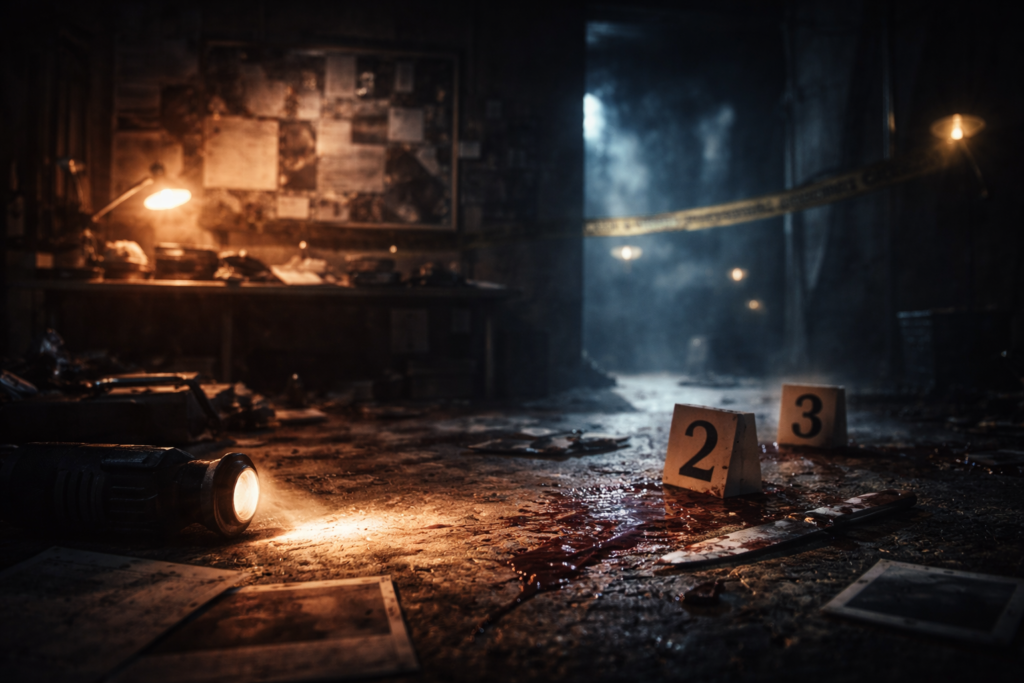
Several key moments in Yohana’s World rely heavily on silence.
Crime scene investigations unfold with minimal dialogue as Yohana studies details others overlook.
Confrontations contain pauses where emotional tension builds without words.
The park confrontation between Yohana and the antagonist becomes particularly powerful because the emotional stakes emerge through behaviour rather than explanation.
These silent moments transform the audience into observers of psychological conflict.
And that observation creates deeper engagement.
Why Behaviour makes Psychological Thrillers more immersive
The strength of visual storytelling in psychological thrillers lies in its ability to transform behaviour into narrative evidence.
When characters reveal themselves through actions rather than explanations, the audience becomes an active participant in the story.
Every glance becomes a clue. Every hesitation becomes a question. Every gesture becomes a fragment of psychological truth.
This interactive experience creates immersion.
Because the audience is not only watching the story, but also interpreting it.
In Yohana’s World, behaviour becomes the language through which internal conflict is revealed.
Yohana’s investigative rituals, emotional restraint and subtle gestures gradually expose the fragile psychology beneath her controlled exterior.
Meanwhile, the antagonist’s calculated composure and sudden flashes of irritation reveal a different kind of psychological fracture.
Together, these behaviours create a silent psychological dialogue: a tension that unfolds through observation rather than explanation.
Invest in Yohana’s World
Yohana’s World is more than just a screenplay.
It is a psychologically layered cinematic narrative built around visual storytelling in psychological thrillers, where behaviour and character dynamics reveal the deeper emotional stakes of the story.
Available for direct acquisition at $555,000, the complete package includes:
• Full feature-length 118 page screenplay
• Scene-by-scene breakdown
• Character psychology profiles
• Visual language framework
• Narrative tension mapping
• Thematic design documentation
For producers, directors, story collectors and development executives seeking psychologically sophisticated storytelling,
invest in Yohana’s World today by registering on its official website.
Because the most powerful psychological thrillers are observed.